This website is managed by Ultima Markets’ international entities, and it’s important to emphasise that they are not subject to regulation by the FCA in the UK. Therefore, you must understand that you will not have the FCA’s protection when investing through this website – for example:
You will not be guaranteed Negative Balance Protection
You will not be protected by FCA’s leverage restrictions
You will not have the right to settle disputes via the Financial Ombudsman Service (FOS)
You will not be protected by Financial Services Compensation Scheme (FSCS)
Any monies deposited will not be afforded the protection required under the FCA Client Assets Sourcebook. The level of protection for your funds will be determined by the regulations of the relevant local regulator.
Note: UK clients are kindly invited to visit https://www.ultima-markets.co.uk/. Ultima Markets UK expects to begin onboarding UK clients in accordance with FCA regulatory requirements in 2026.
If you would like to proceed and visit this website, you acknowledge and confirm the following:
1.The website is owned by Ultima Markets’ international entities and not by Ultima Markets UK Ltd, which is regulated by the FCA.
2.Ultima Markets Limited, or any of the Ultima Markets international entities, are neither based in the UK nor licensed by the FCA.
3.You are accessing the website at your own initiative and have not been solicited by Ultima Markets Limited in any way.
4.Investing through this website does not grant you the protections provided by the FCA.
5.Should you choose to invest through this website or with any of the international Ultima Markets entities, you will be subject to the rules and regulations of the relevant international regulatory authorities, not the FCA.
Ultima Markets wants to make it clear that we are duly licensed and authorised to offer the services and financial derivative products listed on our website. Individuals accessing this website and registering a trading account do so entirely of their own volition and without prior solicitation.
By confirming your decision to proceed with entering the website, you hereby affirm that this decision was solely initiated by you, and no solicitation has been made by any Ultima Markets entity.
Ultima Markets does not have an establishment in Singapore and does not operate from Singapore.
Ultima Markets does not provide products or services to citizens or residents of Singapore, and account applications from Singapore citizens or residents will not be accepted.
If you are a citizen or resident of Singapore, please do not open an account or use Ultima Markets’ products or services.
By selecting “Acknowledge and Continue Browsing”, you confirm that you are accessing this website on your own initiative and that your access is not the result of any direct marketing, targeted advertising, solicitation, or promotional activity by Ultima Markets.
Nothing on this website constitutes an offer, solicitation, or promotion of products or services in any jurisdiction where such activity is prohibited. You are responsible for ensuring that your access to and use of this website complies with applicable local laws and regulations.
Are there any countries not in debt? Discover debt-free governments, low-debt nations and why national debt matters to economies and forex traders today.
Are there any countries not in debt? Yes, when referring to public debt. Monaco’s government states that it has no public debt, making it an example of a debt-free government.
However, this does not mean every household, business or bank within that country is debt-free. It also differs from having very little government debt or financial assets worth more than outstanding borrowing.
The distinction matters as borrowing rises globally. The IMF’s April 2026 Fiscal Monitor estimated global public debt at just under 94% of GDP in 2025 and projected it would reach 100% by 2029.
What Counts as National Debt?
National debt generally refers to outstanding government obligations, rather than all borrowing across an economy. General government debt covers central, regional and local government, alongside relevant social security funds. A narrower central-government figure can therefore leave out some public borrowing.
The debt-to-GDP ratio compares government debt with the size of the economy. For example, £10 billion of debt against annual GDP of £100 billion produces a ratio of 10%. This measures debt relative to economic output, not the proportion of government revenue spent on repayments.
Debt-Free Countries and Important Exceptions
The following examples show why the debt measure and reporting date need to accompany any claim about a debt-free country.
Country
What the official source reports
Reference period
Monaco
The government states that it has no public debt.
Undated official policy statement.
Liechtenstein
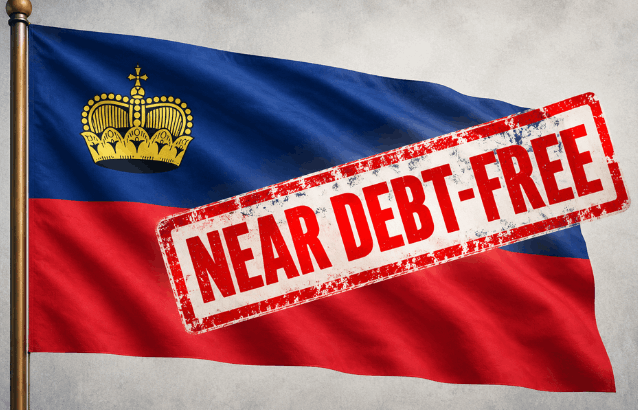
Public debt estimated at 0.5% of GDP.
2025 estimate, published by the IMF in March 2026.
Brunei Darussalam
BND352 million in outstanding government sukuk securities.
3 September 2026.
These are different measures, not a like-for-like ranking. Brunei’s figure covers outstanding government sukuk rather than a comprehensive total of all government liabilities.
Liechtenstein is better described as nearly debt-free, not completely debt-free. Its public finances also do not represent household finances: the IMF separately highlighted elevated household indebtedness in January 2026.
Macao needs a separate label. The IMF’s 2024 consultation report stated that it had no public debt. However, Macao is a Special Administrative Region of China, not an independent country. That historical finding should not be presented as a newly verified 2026 figure.
No Net Debt Is Not the Same as No Debt
To answer “are there any countries not in debt?” accurately, it is also essential to distinguish gross debt from net debt.
Gross debt measures obligations before accounting for financial assets. Net debt deducts relevant financial assets. A government can therefore owe money while holding assets worth more than its debt.
For example, a government with £20 billion in debt and £25 billion in eligible financial assets would have negative net debt of £5 billion. Nevertheless, creditors would still be owed £20 billion.
Singapore illustrates why assets matter. Its Ministry of Finance states that financial assets substantially exceed government debt. Most borrowing proceeds are invested, while a smaller category of borrowing finances nationally significant infrastructure.
Having assets that exceed debt does not remove the obligation to repay it.
Government Debt Versus a Budget Deficit
A budget deficit occurs when spending exceeds revenue over a period. Debt measures outstanding obligations at a particular date. A low debt figure therefore does not, by itself, show whether a government is balancing its budget.
Brunei provides a recent example of why these figures must be read separately. In its assessment published on 23 September 2026, the IMF estimated a fiscal deficit of 18.9% of GDP for FY2025/26, reflecting weaker hydrocarbon revenue and elevated spending.
That 18.9% figure is not Brunei’s debt-to-GDP ratio. It measures a fiscal-year shortfall, whereas the central bank’s sukuk figure measures securities still outstanding.
Why Do Governments Borrow?
Governments may borrow to finance infrastructure, respond to emergencies or maintain services when revenue falls during a recession. Borrowing allows costs to be spread over time rather than funded entirely from current taxation.
They also issue new debt to repay obligations reaching maturity. This process is called refinancing. The OECD’s Global Debt Report 2026 projects that 78% of OECD government borrowing in 2026 will refinance existing debt.
A large borrowing programme therefore does not necessarily mean an equally large increase in total debt. However, replacing older debt at higher interest rates can increase future financing costs.
Why Does National Debt Matter to Traders?
National debt can affect bond yields, borrowing costs and currency sentiment, so it matters to forex and macro traders.
If investors become concerned about a country’s ability to manage its debt, bond yields may rise and confidence in its currency may weaken. However, low debt alone does not guarantee a stronger currency.
Traders should consider debt alongside interest rates, inflation, economic growth and fiscal policy when analysing a country’s financial outlook.
What Does Government Debt Mean for Financial Markets?
For investors, debt sustainability concerns a government’s ability to keep servicing its obligations without a default or extraordinary financial support. When payments fall due and whether refinancing remains available matter alongside the headline debt figure.
Currency exposure is also important. When debt is denominated in foreign currency, depreciation of the domestic currency increases its local-currency cost. Investors may demand higher bond yields when they perceive greater repayment risk.
For forex traders, this means analysing debt alongside borrowing costs and exchange-rate exposure. A low debt ratio alone is not a trading signal.
Conclusion
So, are there any countries not in debt? Yes, when the question concerns public debt, with Monaco providing an official example. However, that statement should not be extended to every household or business within its borders.
The key is to check what the figure measures and when it was reported. Zero debt, low debt and negative net debt describe different situations. Understanding those differences is more useful than relying on an undated list of supposedly debt-free countries.
FAQ
Which country has no national debt?
Monaco’s government states that it has no public debt. This concerns government finances, not every private loan within the country.
Is Singapore debt-free?
Singapore has outstanding government debt, but its Ministry of Finance says financial assets exceed that debt. It therefore describes its position as having no net debt.
Who do countries owe money to?
Creditors include domestic and foreign investors, banks, pension funds, other governments and international institutions. National debt is not simply money owed to another country.
Does having no IMF debt mean a country is debt-free?
No. A government without IMF borrowing may still owe money to bondholders, banks or other lenders.
Share Now
Disclaimer:This content is provided for informational purposes only and does not constitute, and should not be construed as, financial, investment, or other professional advice. No statement or opinion contained herein should be considered a recommendation by Ultima Markets or the author regarding any specific investment product, strategy, or transaction. Readers are advised not to rely solely on this material when making investment decisions and should seek independent advice where appropriate.
Thank you for visiting the Ultima Markets website. Please note that this website is intended for individuals residing in jurisdictions where access is permitted by law. Ultima and its affiliated entities do not operate in your home jurisdiction.
By clicking ‘Acknowledge’, you confirm that you are entering this website solely on your own initiative and not as a result of any specific marketing outreach. You wish to obtain information from this website based on reverse solicitation principles, in accordance with the applicable laws of your home jurisdiction.