This website is managed by Ultima Markets’ international entities, and it’s important to emphasise that they are not subject to regulation by the FCA in the UK. Therefore, you must understand that you will not have the FCA’s protection when investing through this website – for example:
You will not be guaranteed Negative Balance Protection
You will not be protected by FCA’s leverage restrictions
You will not have the right to settle disputes via the Financial Ombudsman Service (FOS)
You will not be protected by Financial Services Compensation Scheme (FSCS)
Any monies deposited will not be afforded the protection required under the FCA Client Assets Sourcebook. The level of protection for your funds will be determined by the regulations of the relevant local regulator.
Note: UK clients are kindly invited to visit https://www.ultima-markets.co.uk/. Ultima Markets UK expects to begin onboarding UK clients in accordance with FCA regulatory requirements in 2026.
If you would like to proceed and visit this website, you acknowledge and confirm the following:
1.The website is owned by Ultima Markets’ international entities and not by Ultima Markets UK Ltd, which is regulated by the FCA.
2.Ultima Markets Limited, or any of the Ultima Markets international entities, are neither based in the UK nor licensed by the FCA.
3.You are accessing the website at your own initiative and have not been solicited by Ultima Markets Limited in any way.
4.Investing through this website does not grant you the protections provided by the FCA.
5.Should you choose to invest through this website or with any of the international Ultima Markets entities, you will be subject to the rules and regulations of the relevant international regulatory authorities, not the FCA.
Ultima Markets wants to make it clear that we are duly licensed and authorised to offer the services and financial derivative products listed on our website. Individuals accessing this website and registering a trading account do so entirely of their own volition and without prior solicitation.
By confirming your decision to proceed with entering the website, you hereby affirm that this decision was solely initiated by you, and no solicitation has been made by any Ultima Markets entity.
Ultima Markets does not have an establishment in Singapore and does not operate from Singapore.
Ultima Markets does not provide products or services to citizens or residents of Singapore, and account applications from Singapore citizens or residents will not be accepted.
If you are a citizen or resident of Singapore, please do not open an account or use Ultima Markets’ products or services.
By selecting “Acknowledge and Continue Browsing”, you confirm that you are accessing this website on your own initiative and that your access is not the result of any direct marketing, targeted advertising, solicitation, or promotional activity by Ultima Markets.
Nothing on this website constitutes an offer, solicitation, or promotion of products or services in any jurisdiction where such activity is prohibited. You are responsible for ensuring that your access to and use of this website complies with applicable local laws and regulations.
Learn the best strategy for day trading with price action, breakout, scalping and momentum techniques to improve analysis, execution and risk control.
Day trading involves opening and closing positions within the same trading session, with traders aiming to benefit from short-term price movements. Unlike long-term investing, day trading requires quick decision-making, strong market analysis and a structured approach to managing risk.
Finding the best strategy for day trading depends on several factors, including market conditions, trading style, experience level and risk management preferences. While no strategy can guarantee success, traders often combine technical analysis, price action and disciplined execution to create a repeatable trading plan.
This guide explores some of the most widely used day trading strategies, how they work and how traders can choose an approach that suits their goals.
What Makes a Good Day Trading Strategy?
A day trading strategy is more than simply identifying when to buy or sell. A complete strategy should include clear rules for analysing markets, entering trades, managing positions and exiting at the right time.
Key elements of an effective trading strategy include:
A defined plan helps traders avoid making decisions based on emotions or short-term market noise.
Risk management
Managing position sizes, setting stop-loss levels and defining acceptable losses are essential parts of responsible trading.
Consistency
The best strategy for day trading is often the one that traders can apply consistently across different market conditions.
Top 7 Best Strategies for Day Trading
1. Price Action Trading Strategy
Price action trading focuses on analysing price movements directly rather than relying only on technical indicators. Traders study candlestick patterns, support and resistance levels and market structure to identify possible trade opportunities.
Common price action signals include:
Hammer and shooting star patterns
Engulfing candlestick patterns
Breaks of support and resistance
Changes in market trends
For example, if a currency pair repeatedly fails to move below a certain support level, traders may watch for signs of a potential reversal before considering a trade.
The advantage of price action trading is that it helps traders understand market behaviour. However, it requires experience because interpreting price movements can be subjective.
2. Breakout Trading Strategy
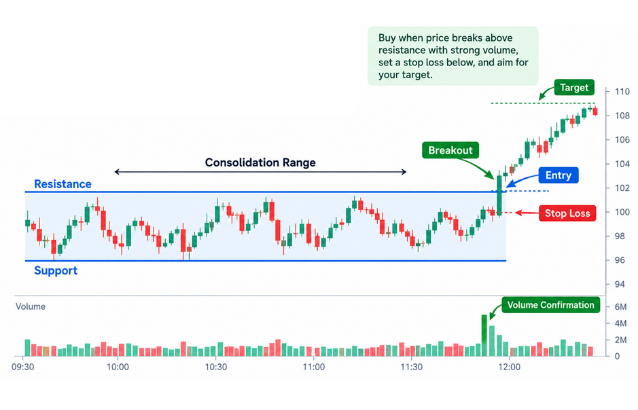
Breakout trading is one of the most popular day trading strategies. It focuses on entering trades when price moves beyond an important support or resistance level.
A breakout may suggest that buying or selling pressure is increasing.
Examples:
A move above resistance may indicate bullish momentum.
A move below support may signal stronger selling pressure.
Many traders combine breakout strategies with volume analysis or momentum indicators to confirm whether the movement has enough strength.
However, traders should be aware of false breakouts, where prices briefly move beyond a key level before reversing. Using confirmation signals and risk management can help reduce exposure to unexpected market movements.
3. Opening Range Breakout Strategy
The opening range breakout strategy focuses on price movements during the beginning of a trading session.
Traders identify the highest and lowest prices formed during the opening period, then monitor whether price breaks beyond this range.
For example:
Breaking above the opening range high may suggest upward momentum.
Breaking below the opening range low may indicate selling pressure.
This approach is commonly used in markets with strong liquidity and higher volatility because early session movements can create clearer opportunities.
However, sudden market reactions caused by economic data releases or unexpected news can create false signals, making risk management important.
4. Scalping Strategy
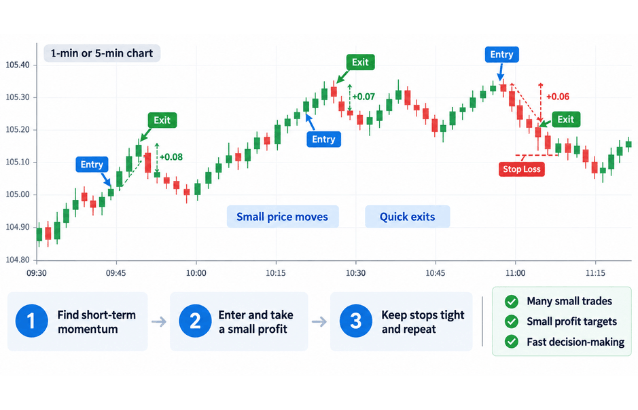
Scalping is a short-term trading approach where traders aim to capture small price movements through multiple trades.
Scalpers usually focus on:
Short timeframes such as one-minute or five-minute charts
Highly liquid markets
Fast execution
A scalper may enter a trade when a short-term price movement appears and close the position once a small target is reached.
The benefit of scalping is that positions are typically held for a short period, reducing exposure to longer market movements. However, it requires discipline, quick decisions and careful control of trading costs.
5. Trend Following Strategy
Trend following focuses on identifying the overall market direction and trading alongside it.
The basic principle is:
Buying during an upward trend
Selling during a downward trend
Traders often use tools such as:
Moving averages
Trendlines
Average Directional Index (ADX)
For example, a trader may look for opportunities when price remains above a moving average, suggesting continued upward momentum.
Trend following can work well during strong market movements but may produce fewer opportunities when prices move sideways.
6. Momentum Trading Strategy
Momentum trading focuses on assets experiencing strong price movement within a short period.
Traders usually look for:
Increased trading volume
Strong price acceleration
Clear market momentum
Common indicators include:
Relative Strength Index (RSI)
Moving Average Convergence Divergence (MACD)
Volume indicators
Momentum strategies can help traders participate in strong market moves, but timing is important. Entering too late may expose traders to sudden reversals.
7. Range Trading Strategy
Not all markets move in strong trends. During periods of sideways movement, some traders use range trading strategies.
Range traders identify areas where price repeatedly moves between support and resistance levels.
For example:
Buying near established support
Selling near established resistance
This strategy works best when markets lack strong directional movement. However, traders need to monitor conditions carefully because a sudden breakout can invalidate the trading range.
How to Choose the Best Strategy for Day Trading
Choosing the right approach depends on your trading objectives, available time and understanding of market behaviour.
Before selecting a strategy, consider:
Your Trading Style
Traders who prefer frequent opportunities may prefer scalping, while those who prefer fewer trades may find trend following or breakout strategies more suitable.
Market Conditions
Different strategies perform better in different environments.
Market Condition
Suitable Strategies
Strong trend
Trend following, momentum
High volatility
Breakout, opening range breakout
Sideways market
Range trading
Short-term movements
Scalping, price action
Testing and Improvement
Before applying a strategy with real capital, traders can practise through backtesting and demo trading. Reviewing historical price movements helps traders understand how a strategy performs in different situations.
Keeping a trading journal can also help identify patterns by recording:
Entry and exit reasons
Market conditions
Trade results
Areas for improvement
Why Risk Management Matters in Day Trading
Even the best strategy for day trading will experience losing trades. Successful trading is not only about finding opportunities but also managing potential losses.
Common risk management practices include:
Setting stop-loss levels
Avoiding oversized positions
Maintaining a consistent risk-to-reward approach
Defining maximum daily losses
A disciplined risk management plan helps traders stay focused and avoid emotional decisions during periods of market volatility.
Common Mistakes Day Traders Should Avoid
Trading Without a Plan
Entering trades without clear rules can lead to inconsistent decisions.
Overtrading
Taking too many positions can increase exposure and make it harder to maintain discipline.
Ignoring Market Conditions
A strategy that works well in a trending market may not perform the same way during periods of low volatility.
Conclusion
The best strategy for day trading is not a single technique that works in every situation. Price action, breakout trading, scalping, momentum and trend following each have their own advantages depending on market conditions.
A structured approach combining technical analysis, careful execution and risk management can help traders build a more consistent trading process. Before using any strategy in live markets, traders should understand its rules, practise its execution and evaluate whether it matches their trading goals.
FAQ
What is the best strategy for day trading?
The best strategy depends on market conditions and trading style. Popular approaches include price action, breakout, scalping and trend following.
Is day trading suitable for beginners?
Beginners can learn day trading strategies, but they should first understand market basics, practise with a demo account and develop risk management skills.
Which indicators are commonly used for day trading?
Common indicators include moving averages, RSI, MACD and volume indicators.
Share Now
Disclaimer:This content is provided for informational purposes only and does not constitute, and should not be construed as, financial, investment, or other professional advice. No statement or opinion contained herein should be considered a recommendation by Ultima Markets or the author regarding any specific investment product, strategy, or transaction. Readers are advised not to rely solely on this material when making investment decisions and should seek independent advice where appropriate.
Thank you for visiting the Ultima Markets website. Please note that this website is intended for individuals residing in jurisdictions where access is permitted by law. Ultima and its affiliated entities do not operate in your home jurisdiction.
By clicking ‘Acknowledge’, you confirm that you are entering this website solely on your own initiative and not as a result of any specific marketing outreach. You wish to obtain information from this website based on reverse solicitation principles, in accordance with the applicable laws of your home jurisdiction.