This website is managed by Ultima Markets’ international entities, and it’s important to emphasise that they are not subject to regulation by the FCA in the UK. Therefore, you must understand that you will not have the FCA’s protection when investing through this website – for example:
You will not be guaranteed Negative Balance Protection
You will not be protected by FCA’s leverage restrictions
You will not have the right to settle disputes via the Financial Ombudsman Service (FOS)
You will not be protected by Financial Services Compensation Scheme (FSCS)
Any monies deposited will not be afforded the protection required under the FCA Client Assets Sourcebook. The level of protection for your funds will be determined by the regulations of the relevant local regulator.
Note: UK clients are kindly invited to visit https://www.ultima-markets.co.uk/. Ultima Markets UK expects to begin onboarding UK clients in accordance with FCA regulatory requirements in 2026.
If you would like to proceed and visit this website, you acknowledge and confirm the following:
1.The website is owned by Ultima Markets’ international entities and not by Ultima Markets UK Ltd, which is regulated by the FCA.
2.Ultima Markets Limited, or any of the Ultima Markets international entities, are neither based in the UK nor licensed by the FCA.
3.You are accessing the website at your own initiative and have not been solicited by Ultima Markets Limited in any way.
4.Investing through this website does not grant you the protections provided by the FCA.
5.Should you choose to invest through this website or with any of the international Ultima Markets entities, you will be subject to the rules and regulations of the relevant international regulatory authorities, not the FCA.
Ultima Markets wants to make it clear that we are duly licensed and authorised to offer the services and financial derivative products listed on our website. Individuals accessing this website and registering a trading account do so entirely of their own volition and without prior solicitation.
By confirming your decision to proceed with entering the website, you hereby affirm that this decision was solely initiated by you, and no solicitation has been made by any Ultima Markets entity.
Ultima Markets does not have an establishment in Singapore and does not operate from Singapore.
Ultima Markets does not provide products or services to citizens or residents of Singapore, and account applications from Singapore citizens or residents will not be accepted.
If you are a citizen or resident of Singapore, please do not open an account or use Ultima Markets’ products or services.
By selecting “Acknowledge and Continue Browsing”, you confirm that you are accessing this website on your own initiative and that your access is not the result of any direct marketing, targeted advertising, solicitation, or promotional activity by Ultima Markets.
Nothing on this website constitutes an offer, solicitation, or promotion of products or services in any jurisdiction where such activity is prohibited. You are responsible for ensuring that your access to and use of this website complies with applicable local laws and regulations.
Learn swing trading step by step, from reading charts and managing risk to practising on a demo account, reviewing trades and building a trading routine.
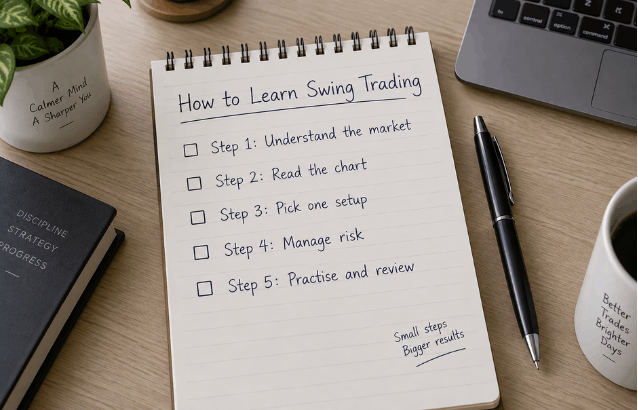
To learn swing trading, start with a process you can practise: understand your market, read price charts, define a trade, calculate its risk and review the outcome. The goal is not to memorise dozens of patterns. It is to make decisions you can explain and test.
Swing trading aims to capture price movements over several days or weeks. Unlike day trading, it commonly involves holding positions overnight, creating exposure to news and price gaps between sessions.
This guide explains what to study first, how to practise and which results deserve your attention.
1. Understand One Market Before Looking for Trades
Begin with one market and a small watchlist. For each instrument, check its trading hours, minimum position size and how price changes translate into profit or loss.
Next, identify its costs. CFD positions may involve spreads, commissions and overnight funding, depending on the instrument and provider. These charges matter when a position remains open for several days.
Make an event check part of your preparation. Note relevant earnings announcements and economic releases before entering a practice trade. News outside trading hours can change the next available price, even when a chart previously looked promising.
Your first exercise is simple: create a one-page instrument profile covering its trading hours, costs and upcoming events.
2. Learn to Read Charts Before Adding Indicators
Start by identifying the market’s direction. Higher highs and higher lows generally describe an uptrend; lower highs and lower lows describe a downtrend.
Then mark support and resistance. Support is an area where buying pressure may interrupt a decline. Resistance is an area where selling pressure may interrupt a rise. Treat both as areas to assess, not guaranteed turning points.
For practice, use a weekly chart for context and a daily chart to examine potential setups. A four-hour chart can provide a closer view, but this is an example, not a universal timeframe combination.
Before adding indicators, write a sentence describing the trend and mark the nearest support and resistance. Aim to explain the chart rather than predict every move.
3. Choose One Setup and Write Its Rules
As you learn swing trading, give yourself one approach to test rather than switching methods after every loss.
Our guide to swing trading strategies explores different approaches. Choose one to study, then translate it into rules you can apply consistently.
Your plan should define the market conditions required, the entry trigger, the point where the idea becomes invalid and your exit method. Predetermined rules help separate a planned trade from an impulsive decision.
For example, “buy a pullback” is incomplete. Specify what qualifies as an uptrend, where the pullback must occur and what confirms entry. Also decide when you will stay out, such as around a scheduled announcement.
4. Calculate Position Size Before Placing an Order
Choose a stop level that reflects where your trade idea would fail, then calculate the position size. Do not choose an oversized position first and squeeze the stop closer just to make the numbers fit.
Consider this hypothetical share trade:
Item
Illustrative figure
Practice account balance
US$5,000
Planned risk allowance
0.5%, or US$25
Entry price
US$50
Stop-loss level
US$49
Price risk per share
US$1
Position size before costs
25 shares
Position size = planned cash risk ÷ price risk per share
Here, US25÷US1 gives 25 shares, representing US$1,250 of exposure. The planned US25lossassumesanexitatUS49 and excludes costs. The percentage is illustrative, not a recommendation.
A target of US52wouldimplyUS50 of gross potential profit, giving a 1:2 risk-to-reward ratio. That ratio says nothing about the probability of reaching the target.
Standard stop-loss orders do not guarantee an execution price. Gaps or fast markets can produce larger losses than planned. Allow for costs and slippage rather than treating the calculation as a maximum-loss guarantee.
5. Test Historical Charts, Then Use a Demo Account
Turn your rules into a practical exercise. Replay historical charts one candle at a time, hiding future prices. Record each qualifying trade before revealing what happened next.
Include unsuccessful setups and different market conditions. After refining your rules, test them on a separate period without adjusting them during that test. This helps address overfitting, where a method is tailored to past data but performs poorly on unseen prices.
Next, apply the same rules in a demo account as new prices arrive. Practise entering orders, managing positions and closing trades with a realistic account balance.
Keep records rather than resetting the account after losses. Include realistic costs in your review, even where the simulator does not model them fully.
Demo trading is useful for learning, but simulated execution and results do not establish that you will succeed with real money.
6. Review Results, Not Just Your Win Rate
To learn swing trading effectively, examine both your decisions and their outcomes.
Keep a journal with your entry reason, stop, target, position size, exit, costs and a chart screenshot. Record whether you followed your rules, then review the journal weekly.
Compare your win rate with average gains, average losses and net results. These measures provide different perspectives on performance. Consider this hypothetical ten-trade sample:
Four wins of US$50 produce US$200, whereas 6 losses of US$25 cost US$150. That leaves US$50 be forecosts, despite a win ratio of only 40%. Average costs of US$6 per trade would turn the result into a US$10 loss.
This is arithmetic, not a performance forecast. It shows why winning often and making money are different questions.
Also review losing streaks and the largest account decline. Before considering live trading, assess whether you can follow the plan consistently and afford the potential losses. A short winning streak is not proof of readiness.
Conclusion
Learning begins with a repeatable process, not a profit target. Study one market, practise one setup, calculate exposure and review what actually happened.
As you learn swing trading, focus on making each decision clearer and each practice session more informative. Let evidence guide your progress rather than the excitement of an individual winning trade.
FAQ
Can I learn swing trading on my own?
Yes. Use structured educational material, chart exercises and demo practice. Test what you learn rather than copying trade signals without understanding them.
How long does it take to learn swing trading?
There is no fixed timetable. Assess progress through documented practice, risk calculations and consistent execution, not a promised number of weeks.
Do I need expensive software to start?
Start with access to price charts, a suitable demo account and a journal. Check that your tools support the market and exercises you intend to practise.
Is swing trading safer than day trading?
Not automatically. Holding positions longer creates overnight and weekend exposure. Risk also depends on position size, leverage and the instrument traded.
Share Now
Disclaimer:This content is provided for informational purposes only and does not constitute, and should not be construed as, financial, investment, or other professional advice. No statement or opinion contained herein should be considered a recommendation by Ultima Markets or the author regarding any specific investment product, strategy, or transaction. Readers are advised not to rely solely on this material when making investment decisions and should seek independent advice where appropriate.
Thank you for visiting the Ultima Markets website. Please note that this website is intended for individuals residing in jurisdictions where access is permitted by law. Ultima and its affiliated entities do not operate in your home jurisdiction.
By clicking ‘Acknowledge’, you confirm that you are entering this website solely on your own initiative and not as a result of any specific marketing outreach. You wish to obtain information from this website based on reverse solicitation principles, in accordance with the applicable laws of your home jurisdiction.