This website is managed by Ultima Markets’ international entities, and it’s important to emphasise that they are not subject to regulation by the FCA in the UK. Therefore, you must understand that you will not have the FCA’s protection when investing through this website – for example:
You will not be guaranteed Negative Balance Protection
You will not be protected by FCA’s leverage restrictions
You will not have the right to settle disputes via the Financial Ombudsman Service (FOS)
You will not be protected by Financial Services Compensation Scheme (FSCS)
Any monies deposited will not be afforded the protection required under the FCA Client Assets Sourcebook. The level of protection for your funds will be determined by the regulations of the relevant local regulator.
Note: UK clients are kindly invited to visit https://www.ultima-markets.co.uk/. Ultima Markets UK expects to begin onboarding UK clients in accordance with FCA regulatory requirements in 2026.
If you would like to proceed and visit this website, you acknowledge and confirm the following:
1.The website is owned by Ultima Markets’ international entities and not by Ultima Markets UK Ltd, which is regulated by the FCA.
2.Ultima Markets Limited, or any of the Ultima Markets international entities, are neither based in the UK nor licensed by the FCA.
3.You are accessing the website at your own initiative and have not been solicited by Ultima Markets Limited in any way.
4.Investing through this website does not grant you the protections provided by the FCA.
5.Should you choose to invest through this website or with any of the international Ultima Markets entities, you will be subject to the rules and regulations of the relevant international regulatory authorities, not the FCA.
Ultima Markets wants to make it clear that we are duly licensed and authorised to offer the services and financial derivative products listed on our website. Individuals accessing this website and registering a trading account do so entirely of their own volition and without prior solicitation.
By confirming your decision to proceed with entering the website, you hereby affirm that this decision was solely initiated by you, and no solicitation has been made by any Ultima Markets entity.
Ultima Markets does not have an establishment in Singapore and does not operate from Singapore.
Ultima Markets does not provide products or services to citizens or residents of Singapore, and account applications from Singapore citizens or residents will not be accepted.
If you are a citizen or resident of Singapore, please do not open an account or use Ultima Markets’ products or services.
By selecting “Acknowledge and Continue Browsing”, you confirm that you are accessing this website on your own initiative and that your access is not the result of any direct marketing, targeted advertising, solicitation, or promotional activity by Ultima Markets.
Nothing on this website constitutes an offer, solicitation, or promotion of products or services in any jurisdiction where such activity is prohibited. You are responsible for ensuring that your access to and use of this website complies with applicable local laws and regulations.
Could there be another Fed rate hike coming soon? Explore the latest odds, inflation risks, market impact and what may shape the Fed’s next move in 2026.
Another Fed rate hike remains possible in 2026, but expectations for an immediate October increase have fallen sharply. After raising interest rates in September, the Federal Reserve is now signalling that it may want more time to assess inflation, employment and financial conditions before tightening policy again.
As of 2 October 2026, markets are pricing only around a 26% probability of another Fed rate hike in October, down from roughly 70% earlier in the week. However, markets still assign around an 80% probability of higher rates after the December meeting, suggesting that investors have delayed rather than abandoned expectations for further tightening.
Is Another Fed Rate Hike Coming in October?
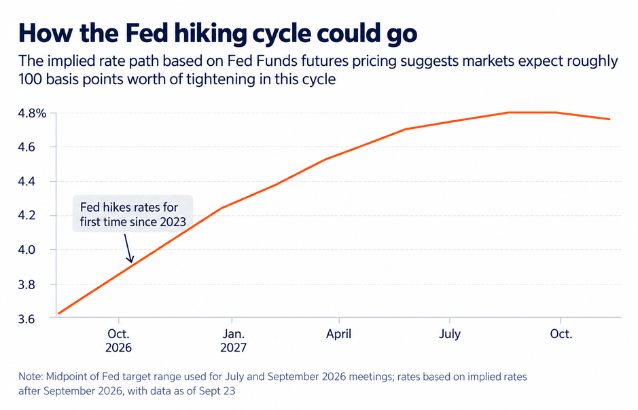
The Federal Reserve raised the federal funds target range by 25 basis points on 16 September to 3.75% to 4.00%, its first increase since 2023. The Fed said economic activity was expanding at a solid pace, domestic spending remained resilient and inflation was still elevated.
The next FOMC meeting takes place on 27 to 28 October, followed by another meeting on 8 to 9 December.
The outlook for October has changed considerably. New York Fed President John Williams has argued that there is no urgency to adjust policy again immediately, while Fed Vice Chair Philip Jefferson said policymakers may need more time and additional data before deciding on the appropriate next step.
This does not mean the tightening cycle is finished. The Fed’s September projections showed a median federal funds rate of 4.1% at the end of 2026, compared with the current midpoint of 3.875%, broadly consistent with another quarter-point increase by year-end.
Image source: Reuters
The debate is increasingly shifting from whether rates need to rise again to when the next increase should happen.
Why Could the Fed Raise Interest Rates Again?
Inflation remains the main reason for another Fed rate hike.
The Fed targets inflation of around 2% over the longer term, but August PCE inflation remained at 3.4% YoY. Core PCE inflation, which excludes food and energy, was lower at 3.0%.
The composition of inflation is particularly important. Much of the recent increase in headline inflation has come from higher energy prices rather than a broad acceleration in underlying inflation.
Jefferson has highlighted several forces currently affecting the US economy, including rising energy prices, large-scale AI infrastructure investment and changes in trade policy. These shocks can support growth while also increasing costs for businesses.
This leaves the Fed with a difficult balance. Raising rates can weaken demand, but it cannot directly increase oil supply or remove supply-chain disruptions.
Macro and Microeconomic Reasons Behind a Fed Rate Hike
From a macroeconomic perspective, policymakers are watching the interaction between inflation, economic growth, employment and financial conditions.
Strong economic demand can keep inflation persistent, while higher energy prices and trade costs can increase prices across the economy. AI-related investment in semiconductors, data centres and infrastructure is also supporting capital spending and growth, potentially making the economy more resilient to higher interest rates.
At the microeconomic level, these pressures appear in the decisions of individual companies and households.
A business facing higher energy, transport, wage or imported-material costs may raise prices to protect profit margins. If consumers continue spending despite those increases, firms may have greater ability to pass their costs on.
This is why the Fed looks beyond one inflation figure. Policymakers analyse whether price pressures are spreading through business costs, wages and consumer demand.
Why Has the October Fed Rate Hike Probability Fallen?
There are three main reasons.
First, inflation data have not deteriorated as much as some investors feared.
Second, senior Fed officials have indicated that they want more time to evaluate the economy. Williams and Jefferson have both emphasised patience rather than a back-to-back increase in October. Market pricing responded quickly, with the implied October probability falling from roughly 70% to around 25% to 28%.
Third, bond markets are already tightening financial conditions.
The 10-year Treasury yield recently reached around 5.34%, its highest level since 2002. Higher government bond yields can push borrowing costs higher for mortgages and businesses even without another Fed move.
If market rates remain elevated, they can slow spending and investment themselves. This could reduce how much additional tightening the Fed needs to deliver directly.
What Happens If There Is Another Fed Rate Hike?
Another Fed rate hike could affect currencies, commodities, bonds, equities and borrowing costs.
For the US dollar, higher rates can support demand for dollar-denominated assets, particularly when US yields rise relative to those in other economies.
For gold, higher Treasury yields can increase the opportunity cost of holding a non-interest-paying asset. A stronger dollar may add further pressure, although geopolitical risk and inflation concerns can still support gold.
For bonds, short-term yields tend to respond closely to expectations for Fed policy. Long-term yields are also influenced by inflation, government borrowing and term premiums.
For stocks, history suggests the short-term impact can be negative, but the relationship is far from automatic.
LPL Financial data covering six tightening cycles since 1994 show that the S&P 500 recorded a median decline of 2.6% during the first three months after the initial rate hike. RBC Capital Markets found that in five of those cycles, peak-to-trough declines ranged between 8% and 14%, usually occurring within roughly one to three and a half months after the first increase.
The 2022 cycle was considerably more severe. The S&P 500 fell about 25% from its peak, while the Fed ultimately raised rates by 525 basis points.
However, history also shows that markets can recover. A year after the first hike, the S&P 500 was 6.8% higher on a median basis, with positive 12-month returns in every cycle examined except 2022 to 2023.
This suggests the pace of tightening and the strength of the economy may matter more than the existence of a rate hike alone.
Is the Current Hiking Cycle Different From 2022?
The 2022 cycle provides a useful comparison because it was unusually aggressive.
Since 1983, the average Fed tightening cycle has lasted just under two years and raised rates by about 320 basis points, according to data cited by Reuters. The 2022 to 2023 cycle involved 525 basis points of tightening.
By contrast, the Fed’s September 2026 projections imply a much smaller amount of additional tightening this year.
That distinction matters for markets. A gradual tightening cycle may give companies and households more time to adjust to higher borrowing costs than a rapid sequence of large increases.
What Could Change the Fed Rate Hike Probability?
Indicator
Could increase hike expectations
Could reduce hike expectations
CPI and PCE
Inflation accelerates
Inflation continues cooling
Employment
Hiring remains strong
Hiring weakens sharply
Unemployment
Remains low
Rises materially
Wage growth
Accelerates
Continues moderating
Oil prices
Stay elevated
Energy pressure fades
Consumer spending
Remains resilient
Demand slows
Treasury yields
Fall despite strong growth
Remain high and tighten conditions
The September jobs report is the next major test. Economists surveyed by Reuters expect approximately 90,000 new jobs, with unemployment holding at around 4.1%. A stronger-than-expected report could revive some October hike expectations, while weaker data could strengthen the argument for waiting.
Fed Rate Hike Outlook for the Rest of 2026
The latest evidence suggests that another Fed rate hike in 2026 remains firmly in consideration, but an October increase has become a lower-probability outcome.
Inflation remains above target and parts of the economy remain resilient, giving policymakers reasons to maintain a restrictive stance. At the same time, softer underlying inflation, cautious Fed communication and sharply higher long-term bond yields are reducing the urgency for another immediate move.
As of 2 October, markets assign only around a one-in-four probability to an October increase, while December remains the more closely watched meeting.
The key question is therefore no longer simply whether the Fed will raise rates again. It is whether incoming inflation, labour-market and financial-condition data justify acting in October, waiting until December, or delaying further tightening into 2027.
FAQ
Will the Fed raise rates in October 2026?
Markets currently imply roughly a 25% to 30% probability of an October increase, significantly lower than earlier in the week.
When is the next Fed meeting?
The next FOMC meeting takes place on 27 to 28 October 2026
What happens to stocks when the Fed raises rates?
Stocks have historically shown some short-term weakness after the first hike, although past cycles also show that markets can recover within a year.
Why does the Fed raise interest rates?
The Fed raises rates to reduce demand and help bring inflation back towards its 2% objective.
Share Now
Disclaimer:This content is provided for informational purposes only and does not constitute, and should not be construed as, financial, investment, or other professional advice. No statement or opinion contained herein should be considered a recommendation by Ultima Markets or the author regarding any specific investment product, strategy, or transaction. Readers are advised not to rely solely on this material when making investment decisions and should seek independent advice where appropriate.
Thank you for visiting the Ultima Markets website. Please note that this website is intended for individuals residing in jurisdictions where access is permitted by law. Ultima and its affiliated entities do not operate in your home jurisdiction.
By clicking ‘Acknowledge’, you confirm that you are entering this website solely on your own initiative and not as a result of any specific marketing outreach. You wish to obtain information from this website based on reverse solicitation principles, in accordance with the applicable laws of your home jurisdiction.