This website is managed by Ultima Markets’ international entities, and it’s important to emphasise that they are not subject to regulation by the FCA in the UK. Therefore, you must understand that you will not have the FCA’s protection when investing through this website – for example:
You will not be guaranteed Negative Balance Protection
You will not be protected by FCA’s leverage restrictions
You will not have the right to settle disputes via the Financial Ombudsman Service (FOS)
You will not be protected by Financial Services Compensation Scheme (FSCS)
Any monies deposited will not be afforded the protection required under the FCA Client Assets Sourcebook. The level of protection for your funds will be determined by the regulations of the relevant local regulator.
Note: UK clients are kindly invited to visit https://www.ultima-markets.co.uk/. Ultima Markets UK expects to begin onboarding UK clients in accordance with FCA regulatory requirements in 2026.
If you would like to proceed and visit this website, you acknowledge and confirm the following:
1.The website is owned by Ultima Markets’ international entities and not by Ultima Markets UK Ltd, which is regulated by the FCA.
2.Ultima Markets Limited, or any of the Ultima Markets international entities, are neither based in the UK nor licensed by the FCA.
3.You are accessing the website at your own initiative and have not been solicited by Ultima Markets Limited in any way.
4.Investing through this website does not grant you the protections provided by the FCA.
5.Should you choose to invest through this website or with any of the international Ultima Markets entities, you will be subject to the rules and regulations of the relevant international regulatory authorities, not the FCA.
Ultima Markets wants to make it clear that we are duly licensed and authorised to offer the services and financial derivative products listed on our website. Individuals accessing this website and registering a trading account do so entirely of their own volition and without prior solicitation.
By confirming your decision to proceed with entering the website, you hereby affirm that this decision was solely initiated by you, and no solicitation has been made by any Ultima Markets entity.
Ultima Markets does not have an establishment in Singapore and does not operate from Singapore.
Ultima Markets does not provide products or services to citizens or residents of Singapore, and account applications from Singapore citizens or residents will not be accepted.
If you are a citizen or resident of Singapore, please do not open an account or use Ultima Markets’ products or services.
By selecting “Acknowledge and Continue Browsing”, you confirm that you are accessing this website on your own initiative and that your access is not the result of any direct marketing, targeted advertising, solicitation, or promotional activity by Ultima Markets.
Nothing on this website constitutes an offer, solicitation, or promotion of products or services in any jurisdiction where such activity is prohibited. You are responsible for ensuring that your access to and use of this website complies with applicable local laws and regulations.
RBA Hawkish Hike Fails to Lift Aussie: What Next for AUD/USD?
RBA Hawkish Hike Fails to Lift Aussie: What Next for AUD/USD?
At its September monetary policy meeting, the Reserve Bank of Australia (RBA) delivered a widely anticipated 25-basis-point rate hike, lifting the Official Cash Rate (OCR) to 4.60%. The decision was accompanied by a firmly hawkish policy statement, as Governor Michele Bullock and the Monetary Policy Board emphasized that returning inflation to the 2%–3% target band remains their highest priority.
Under normal FX conditions, a rate hike paired with a persistent hawkish stance acts as an immediate catalyst for currency appreciation. However, AUD/USD slipped sharply post-announcement, breaking below key psychological levels toward the 0.6930 area.
This analysis breaks down the RBA’s policy statement, examines the macro drivers behind the Aussie Dollar’s paradoxical drop—specifically broad U.S. Dollar (USD) dominance and surging global bond yields—and sets the backdrop for what lies ahead for AUD/USD.
RBA September Rate Decision & Policy Statement
In its September meeting, the RBA increased the cash rate target by 25 bps from 4.35% to 4.60%. The decision was passed unanimously by the Monetary Policy Board, marking its fourth rate hike in 2026 and bringing borrowing costs to their highest level since late 2011. The Board explicitly identified stubborn inflation pressures as the core motivation behind the tightening.
Core Takeaways from the Policy Statement:
Stubbornly High Inflation: The RBA noted that domestic inflation remains elevated and above its target range.
Materializing Upside Risks: The Board highlighted that several upside inflation risks flagged during the August meeting were actively materializing.
Broad-Based Domestic Pressures: Persistent price inflation in non-tradable sectors, ongoing labor supply constraints, and resilient domestic demand forced the central bank to resume tightening after holding rates steady at prior meetings.
Governor Bullock reiterated that the Board “does not rule anything in or out” and will remain strictly data-dependent. The statement clearly signaled that a fourth-quarter hike remains on the table if incoming quarterly CPI data fails to show meaningful deceleration. Consequently, money markets adjusted their expectations, eliminating near-term pricing for RBA rate cuts and pushing potential monetary easing deep into late 2027.
AUD/USD Slips on Hawkish RBA
Immediately following the rate announcement, AUD/USD experienced a brief, knee-jerk attempt to bounce toward the 0.7030 resistance level. However, the upside momentum quickly faded as Governor Bullock’s press conference began. Sellers aggressively took control, driving the pair down through the psychological 0.7000 handle to hit intraday lows around 0.6978, eventually breaking toward the 0.6930 zone.
The core reason AUD/USD declined despite domestic hawkishness lies in a classic “sell-the-fact” dynamic combined with powerful global macro headwinds.
1. “Sell-the-Fact” Dynamic & Full Market Pricing
Prior to the September meeting, interest rate swap markets had already priced in an 85% to 90% probability of a 25 bps rate hike. Because the hawkish narrative was already discounted into the asset price, the actual announcement generated little incremental buying pressure.
Once the RBA decision was confirmed, institutional market participants used the liquidity event to take profits on existing long-AUD positions, triggering an immediate pullback.
2. Broad U.S. Dollar Strength Driven by Hawkish Fed Expectations
Added to that, the Aussie weakened against the dollar primarily because the Greenback remains the central driver of global FX price action. The Australian Dollar represents only one half of the AUD/USD pair, and overall market direction remains heavily anchored by the U.S. Dollar Index (DXY).
Federal Reserve Hawkish Alignment: While the RBA is hawkish, the Federal Reserve has maintained its own firm posture regarding elevated interest rates. Resilient economic growth in the United States and persistent inflation metrics have kept Fed rate expectations elevated.
DXY Strength Prevails: The Greenback appreciated against almost all G10 currencies. In a market regime dominated by broad USD demand, isolated central bank rate hikes outside the U.S. struggle to generate sustained upward momentum.
3. Rising U.S. Treasury Yields & Global Sovereign Bond Pressure
Currency valuations are heavily anchored to relative yield differentials rather than absolute interest rates.
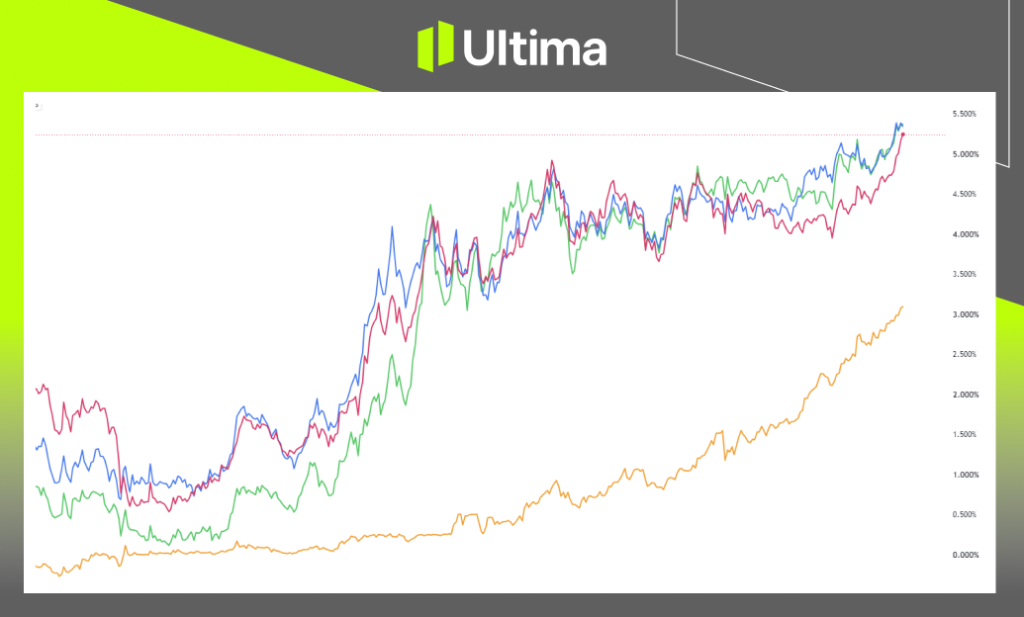
Simultaneously with the RBA’s decision, benchmark U.S. Treasury yields—particularly the 2-year and 10-year notes—experienced an upward repricing. This surge in U.S. risk-free yields widened the yield spread in favor of the Greenback, effectively neutralizing the yield advantage Australia gained from raising its OCR to 4.60%.
As sovereign bond yields rose globally, capital prioritized high-liquidity U.S. dollar assets, eroding the relative carry-trade appeal of the AUD.
What’s Next for AUD/USD?
Despite establishing a solid fundamental foundation backed by a hawkish central bank, AUD/USD remains caught in a tug-of-war between strong domestic monetary support and dominant global macroeconomic headwinds.
On the domestic front, the RBA’s monetary policy stance provides a distinct bullish anchor for the Australian Dollar. With the Official Cash Rate (OCR) raised to 4.60% and persistent inflation keeping the door open for another potential rate hike in Q4, domestic yields remain supported.
However, this domestic strength is heavily offset by bearish forces emanating from the United States:
Elevated U.S. Terminal Rates: Resilient U.S. economic performance continues to keep Federal Reserve terminal rate expectations elevated, anchoring broad demand for the Greenback.
Eroding Carry Trade Appeal: Elevated U.S. Treasury yields pull institutional capital into USD-denominated assets, gradually eroding Australia’s relative yield advantage.
Neutral External Drivers: Global commodity demand and broad risk sentiment present a neutral-to-mixed picture, leaving the Aussie Dollar exposed to broad macroeconomic trends rather than its export fundamentals.
AUDUSD: Technical & Strategic Outlook
To evaluate where AUD/USD is heading next, traders must separate the outlook into two distinct timeframes, as different macroeconomic drivers dominate each horizon.
AUDUSD Short-Term Price Action Tilted to Downside
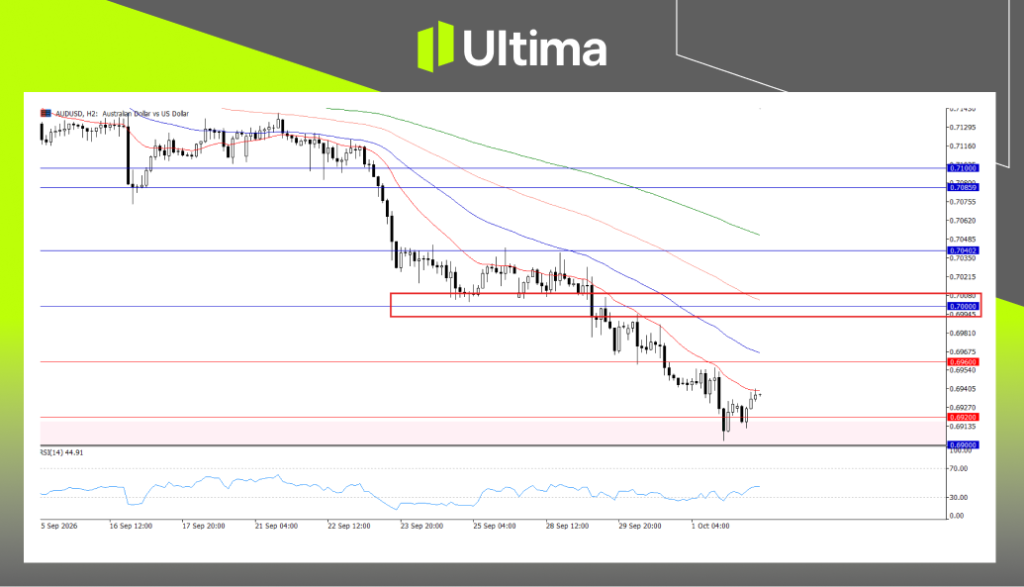
AUDUSD, H2 Chart | Ultima Markets MT5
In the short term, AUD/USD is expected to remain constrained by broad U.S. Dollar strength until U.S. economic indicators or Treasury yields show clear signs of cooling.
Technically, the market structure has shifted downward following the decisive breakdown below the key 0.7000 psychological floor (which previously acted as a strong demand zone). As long as broad Dollar dominance persists, the path of least resistance remains tilted to the downside.
A sustained breakdown below key support near 0.6907 would signal further downside acceleration toward the 0.6860–0.6875 region. In the short run, fundamental reasons for the Aussie to gain against a rising Dollar remain scarce.
AUDUSD Mid-To-Long-Term: Hawkish RBA and Fed Turn
For broader outlook, mid to long term (in coming 1-2 months), the upside is rely on dollar and how dollar can be driven, particularly if economic data and US treasury manage to ease, U.S. Non-Farm Payrolls (NFP) and U.S. Core PCE inflation. Any softer-than-expected data could soften U.S. bond yields, removing the immediate buffer under the Greenback, then AUDUSD have hope to up.
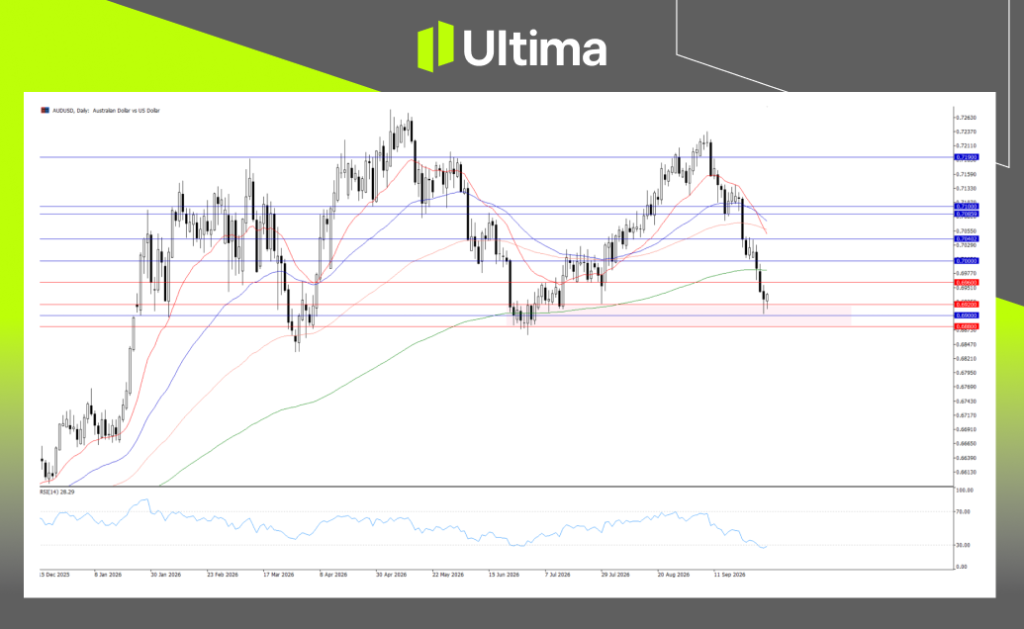
AUDUSD, Daily Chart | Source: Ultima Markets MT5
Over a 1-to-2-month horizon, any meaningful upside recovery for AUD/USD relies almost entirely on the path of the U.S. Dollar and Treasury yields.
Technically, AUD/USD is currently approaching the 0.6900 region—a key multi-year structural support zone where price action is likely to bottom out. While this area provides a reliable technical floor, a bottoming process differs from an immediate bullish recovery. A true reversal requires structural shifts from both sides of the currency pair:
For the U.S. Dollar Side (The Primary Catalyst): Upside momentum in AUD/USD will require U.S. bond yields to soften. Traders should closely monitor upcoming tier-1 releases, specifically U.S. Non-Farm Payrolls (NFP) and U.S. Core PCE inflation. Any weaker-than-expected data could push Treasury yields lower, stripping the Greenback of its recent yield advantage and opening the door for an AUD rebound.
For the Aussie Side (The Underlying Buffer): Market participants should watch the upcoming quarterly Australian CPI report. If domestic inflation remains stubbornly elevated, it will reinforce pricing for a second Q4 RBA rate hike, allowing Australia’s structural hawkishness to reassert itself as a driver for broader recovery once USD pressure subsides.
Disclaimer
Comments, news, research, analysis, price, and all information contained in the article only serve as general information for readers and do not suggest any advice. Ultima Markets has taken reasonable measures to provide up-to-date information, but cannot guarantee accuracy, and may modify without notice. Ultima Markets will not be responsible for any loss incurred due to the application of the information provided.
Thank you for visiting the Ultima Markets website. Please note that this website is intended for individuals residing in jurisdictions where access is permitted by law. Ultima and its affiliated entities do not operate in your home jurisdiction.
By clicking ‘Acknowledge’, you confirm that you are entering this website solely on your own initiative and not as a result of any specific marketing outreach. You wish to obtain information from this website based on reverse solicitation principles, in accordance with the applicable laws of your home jurisdiction.