This website is managed by Ultima Markets’ international entities, and it’s important to emphasise that they are not subject to regulation by the FCA in the UK. Therefore, you must understand that you will not have the FCA’s protection when investing through this website – for example:
You will not be guaranteed Negative Balance Protection
You will not be protected by FCA’s leverage restrictions
You will not have the right to settle disputes via the Financial Ombudsman Service (FOS)
You will not be protected by Financial Services Compensation Scheme (FSCS)
Any monies deposited will not be afforded the protection required under the FCA Client Assets Sourcebook. The level of protection for your funds will be determined by the regulations of the relevant local regulator.
Note: UK clients are kindly invited to visit https://www.ultima-markets.co.uk/. Ultima Markets UK expects to begin onboarding UK clients in accordance with FCA regulatory requirements in 2026.
If you would like to proceed and visit this website, you acknowledge and confirm the following:
1.The website is owned by Ultima Markets’ international entities and not by Ultima Markets UK Ltd, which is regulated by the FCA.
2.Ultima Markets Limited, or any of the Ultima Markets international entities, are neither based in the UK nor licensed by the FCA.
3.You are accessing the website at your own initiative and have not been solicited by Ultima Markets Limited in any way.
4.Investing through this website does not grant you the protections provided by the FCA.
5.Should you choose to invest through this website or with any of the international Ultima Markets entities, you will be subject to the rules and regulations of the relevant international regulatory authorities, not the FCA.
Ultima Markets wants to make it clear that we are duly licensed and authorised to offer the services and financial derivative products listed on our website. Individuals accessing this website and registering a trading account do so entirely of their own volition and without prior solicitation.
By confirming your decision to proceed with entering the website, you hereby affirm that this decision was solely initiated by you, and no solicitation has been made by any Ultima Markets entity.
Ultima Markets does not have an establishment in Singapore and does not operate from Singapore.
Ultima Markets does not provide products or services to citizens or residents of Singapore, and account applications from Singapore citizens or residents will not be accepted.
If you are a citizen or resident of Singapore, please do not open an account or use Ultima Markets’ products or services.
By selecting “Acknowledge and Continue Browsing”, you confirm that you are accessing this website on your own initiative and that your access is not the result of any direct marketing, targeted advertising, solicitation, or promotional activity by Ultima Markets.
Nothing on this website constitutes an offer, solicitation, or promotion of products or services in any jurisdiction where such activity is prohibited. You are responsible for ensuring that your access to and use of this website complies with applicable local laws and regulations.
What is forex trading? Learn how currency pairs work, explore a simple trading example and understand costs, leverage and risks before you start trading.
If you have exchanged money before an overseas trip, you have encountered an exchange rate. But what is forex trading, and how does it differ from buying holiday money?
Forex trading, also called foreign exchange or FX trading, involves buying one currency while selling another. Speculative traders aim to profit from changes in exchange rates, rather than simply obtaining foreign currency to spend.
Understanding the basics starts with three questions: what are you trading, how is your profit or loss calculated, and what could go wrong?
What Is Forex Trading Used For?
Businesses exchange currencies to pay overseas suppliers. Investors use forex to manage currency exposure, while traders speculate on price movements. Protecting an investment against exchange-rate changes is known as currency hedging.
Much of the forex market operates over the counter (OTC), through banks and dealers rather than one central exchange. According to the Bank for International Settlements (BIS), global FX turnover averaged approximately USD 9.5 trillion a day in April 2025. This includes spot transactions and derivatives, not just retail trading.
How Does Forex Trading Work?
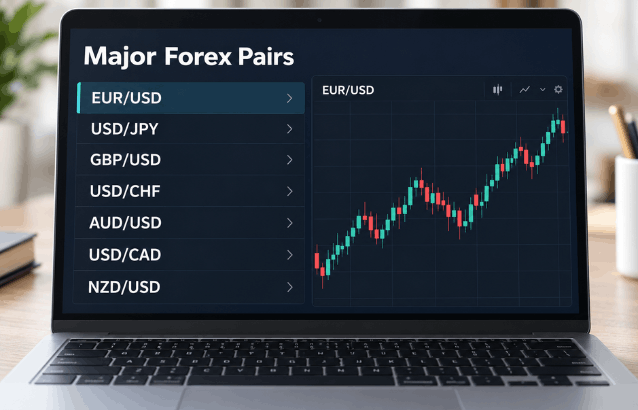
Currencies are quoted in pairs. For example, EUR/USD = 1.1000 means one euro is worth 1.1000 US dollars.
The first currency, EUR, is the base currency. The second, USD, is the quote currency, which expresses the base currency’s value.
Buying EUR/USD, known as going long, expresses an expectation that the euro will strengthen against the dollar. Selling it, or going short, expresses the opposite view. A long position benefits from a rising exchange rate; a short position benefits from a falling rate, before costs.
Other commonly traded pairs include GBP/USD, the British pound against the US dollar, and USD/JPY, the US dollar against the Japanese yen.
Forex Trading vs Forex CFDs
The product matters. Exchanging money through a bank gives you foreign currency to hold or spend. A forex contract for difference (CFD) instead lets you speculate on a currency pair without owning the underlying currencies. Retail forex CFDs commonly use leverage, which increases exposure relative to the money committed.
Forex Trading Example: From Prices to Profit
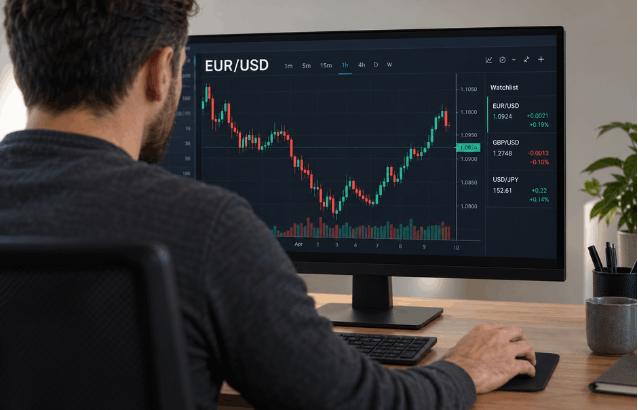
Before calculating a trade, understand the prices on your screen. The ask is the price at which you buy; the bid is the price at which you sell. Their difference is the spread.
Price movements are measured in pips. One pip is usually 0.0001, although it is generally 0.01 for yen-quoted pairs such as USD/JPY.
Position sizes are often expressed in lots. A standard lot commonly represents 100,000 units of the base currency, a mini lot 10,000 and a micro lot 1,000.
Now suppose EUR/USD is quoted at 1.1000 / 1.1002. You expect the euro to strengthen and open a buy position equivalent to EUR 10,000, entering at the ask price of 1.1002.
The spread is 0.0002, or 2 pips.
Hypothetical outcome
Closing bid price
Calculation
Result
Close immediately, with prices unchanged
1.1000
(1.1000 − 1.1002) × 10,000
USD 2 loss
Close after the price rises
1.1050
(1.1050 − 1.1002) × 10,000
USD 48 profit
Close after the price falls
1.0950
(1.0950 − 1.1002) × 10,000
USD 52 loss
These illustrations exclude commissions, overnight financing and currency-conversion charges.
The initial USD 2 loss explains why a new position can start below zero. The spread is already reflected in these entry and exit prices, so it should not be subtracted again.
Some accounts also charge commissions, while positions held overnight may incur financing charges. Zero commission does not mean zero trading costs.
What Causes Forex Prices to Move?
Exchange rates respond to changing supply and demand. Three influences are particularly useful for beginners to understand.
Interest rates: Higher interest rates can attract investment into a currency, but the comparison with other economies matters. A country’s interest rate is only part of the picture, not a reliable signal on its own.
Economic conditions: Growth, trade conditions and the relative economic outlook influence currency demand. New information can change how investors assess one economy compared with another.
Politics and market confidence: Trade policies and uncertainty can alter investment decisions. For example, the BIS linked increased FX activity in April 2025 partly to US tariff announcements and investors adjusting their currency hedges.
The practical lesson is to compare both sides of a currency pair, rather than assume that one positive headline guarantees a rise.
When Can You Trade Forex?
The conventional forex market operates approximately 24 hours a day, five days a week, as activity moves between Asia-Pacific, European and North American financial centres. It generally closes over the weekend, although exact product hours and daily breaks depend on the broker.
Is Forex Trading Risky?
Yes, particularly when leverage is involved. Leverage allows a larger position to be controlled with a smaller amount of capital, called margin. Profits and losses are based on the full position, not just the margin.
For example, at 10:1 leverage, USD 1,000 of margin supports a position worth USD 10,000. A 1% adverse movement would produce approximately USD 100 of losses before costs, equivalent to 10% of that margin.
Margin is not a fee or a guaranteed maximum loss. A broker may automatically close positions when the funds supporting them fall below required levels. Rules on leverage and loss protection vary by jurisdiction, provider and client classification.
Sudden price changes can also cause slippage, when an order executes at a different price from the one expected. A stop-loss order is intended to close a position when a specified price level is reached, but an ordinary stop-loss does not guarantee the execution price.
How to Start Learning Forex Trading
Start by studying one currency pair and practising order placement with virtual funds. Use demo practice to calculate position sizes, understand costs and record why you would enter or exit a trade. Do not treat demo profits as proof of future live results.
Before depositing, verify the exact company behind your account, its relevant regulatory permissions and its official contact details. Check these through the appropriate regulator’s register, rather than relying on a brand name alone.
Build a trading plan that defines your position size, intended exit and acceptable loss before entering. Avoid committing money needed for essential expenses.
Conclusion
Understanding forex means more than predicting whether a currency will rise or fall. You also need to know what product you are trading, how costs affect the result and how much exposure you are taking.
Build that understanding before risking real money. Being able to explain a trade’s potential loss is just as important as calculating its possible profit.
FAQ
What is forex trading in simple terms?
It means trading one currency against another, usually to benefit from changes in their relative values.
Can beginners trade forex?
Beginners can learn the mechanics, but leveraged forex products are high risk and are not suitable for everyone.
How much money do you need to start?
There is no universal amount. Check the broker’s minimum deposit, available position sizes, margin requirements and fees.
Is forex trading a reliable income source?
No income is guaranteed. Market movements, leverage and trading costs can produce substantial losses.
Share Now
Disclaimer:This content is provided for informational purposes only and does not constitute, and should not be construed as, financial, investment, or other professional advice. No statement or opinion contained herein should be considered a recommendation by Ultima Markets or the author regarding any specific investment product, strategy, or transaction. Readers are advised not to rely solely on this material when making investment decisions and should seek independent advice where appropriate.
Thank you for visiting the Ultima Markets website. Please note that this website is intended for individuals residing in jurisdictions where access is permitted by law. Ultima and its affiliated entities do not operate in your home jurisdiction.
By clicking ‘Acknowledge’, you confirm that you are entering this website solely on your own initiative and not as a result of any specific marketing outreach. You wish to obtain information from this website based on reverse solicitation principles, in accordance with the applicable laws of your home jurisdiction.