This website is managed by Ultima Markets’ international entities, and it’s important to emphasise that they are not subject to regulation by the FCA in the UK. Therefore, you must understand that you will not have the FCA’s protection when investing through this website – for example:
You will not be guaranteed Negative Balance Protection
You will not be protected by FCA’s leverage restrictions
You will not have the right to settle disputes via the Financial Ombudsman Service (FOS)
You will not be protected by Financial Services Compensation Scheme (FSCS)
Any monies deposited will not be afforded the protection required under the FCA Client Assets Sourcebook. The level of protection for your funds will be determined by the regulations of the relevant local regulator.
Note: UK clients are kindly invited to visit https://www.ultima-markets.co.uk/. Ultima Markets UK expects to begin onboarding UK clients in accordance with FCA regulatory requirements in 2026.
If you would like to proceed and visit this website, you acknowledge and confirm the following:
1.The website is owned by Ultima Markets’ international entities and not by Ultima Markets UK Ltd, which is regulated by the FCA.
2.Ultima Markets Limited, or any of the Ultima Markets international entities, are neither based in the UK nor licensed by the FCA.
3.You are accessing the website at your own initiative and have not been solicited by Ultima Markets Limited in any way.
4.Investing through this website does not grant you the protections provided by the FCA.
5.Should you choose to invest through this website or with any of the international Ultima Markets entities, you will be subject to the rules and regulations of the relevant international regulatory authorities, not the FCA.
Ultima Markets wants to make it clear that we are duly licensed and authorised to offer the services and financial derivative products listed on our website. Individuals accessing this website and registering a trading account do so entirely of their own volition and without prior solicitation.
By confirming your decision to proceed with entering the website, you hereby affirm that this decision was solely initiated by you, and no solicitation has been made by any Ultima Markets entity.
Ultima Markets does not have an establishment in Singapore and does not operate from Singapore.
Ultima Markets does not provide products or services to citizens or residents of Singapore, and account applications from Singapore citizens or residents will not be accepted.
If you are a citizen or resident of Singapore, please do not open an account or use Ultima Markets’ products or services.
By selecting “Acknowledge and Continue Browsing”, you confirm that you are accessing this website on your own initiative and that your access is not the result of any direct marketing, targeted advertising, solicitation, or promotional activity by Ultima Markets.
Nothing on this website constitutes an offer, solicitation, or promotion of products or services in any jurisdiction where such activity is prohibited. You are responsible for ensuring that your access to and use of this website complies with applicable local laws and regulations.
What is a currency pair? Learn how base and quote currencies work, how forex pairs move, and the differences between major, minor and exotic pairs today.
If you are new to forex, one of the first questions you are likely to ask is what is a currency pair? Put simply, a currency pair shows the value of one currency compared with another. Instead of trading a currency on its own, the forex market always measures it against a second currency.
EUR/USD, GBP/USD and USD/JPY are common examples. Each contains two currencies, and movements in the exchange rate tell traders whether one currency is strengthening or weakening relative to the other.
Understanding how currency pairs are quoted, what makes them move and how their trading costs differ gives you a solid starting point for learning how the forex market works.
What Is a Currency Pair?
So, what is a currency pair in practical terms?
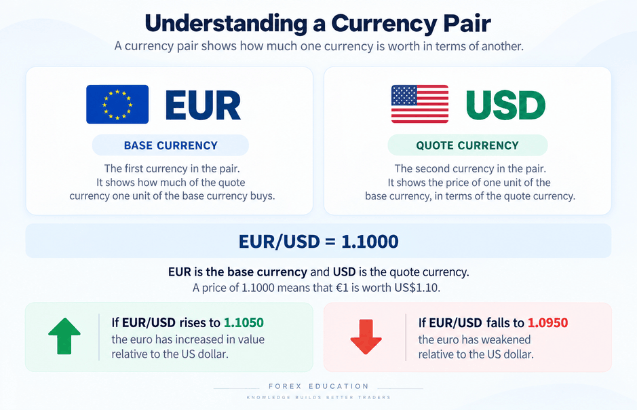
A currency pair is made up of a base currency and a quote currency. The base currency appears first, while the quote currency appears second.
For example:
EUR/USD = 1.1000
EUR is the base currency and USD is the quote currency. A price of 1.1000 means that €1 is worth US$1.10.
If EUR/USD rises to 1.1050, the euro has increased in value relative to the US dollar. If the pair falls to 1.0950, the euro has weakened relative to the dollar.
This relative relationship is important. A currency does not simply rise or fall by itself. Its value is always being compared with another currency.
The familiar three-letter abbreviations such as USD, EUR, GBP and JPY are based on internationally recognised ISO 4217 currency codes. For example, USD represents the US dollar, while JPY represents the Japanese yen.
How Do You Read a Currency Pair?
The easiest way to read a pair is to think of the first currency as what you are measuring and the second as what you are using to measure it.
Currency Pair
Base Currency
Quote Currency
Meaning
EUR/USD
EUR
USD
How many US dollars equal €1
GBP/USD
GBP
USD
How many US dollars equal £1
USD/JPY
USD
JPY
How many yen equal US$1
AUD/USD
AUD
USD
How many US dollars equal A$1
EUR/GBP
EUR
GBP
How many pounds equal €1
When you buy a currency pair, you are effectively buying the base currency while selling the quote currency. When you sell the pair, you are doing the opposite.
For example, buying EUR/USD expresses the view that the euro may strengthen against the US dollar. Selling EUR/USD expresses the view that the euro may weaken against the dollar.
With forex CFDs, traders typically speculate on these price movements without physically exchanging and taking delivery of the currencies.
What Are Major, Minor and Exotic Currency Pairs?
Once you understand what is a currency pair, the next step is knowing that not every pair trades under the same market conditions.
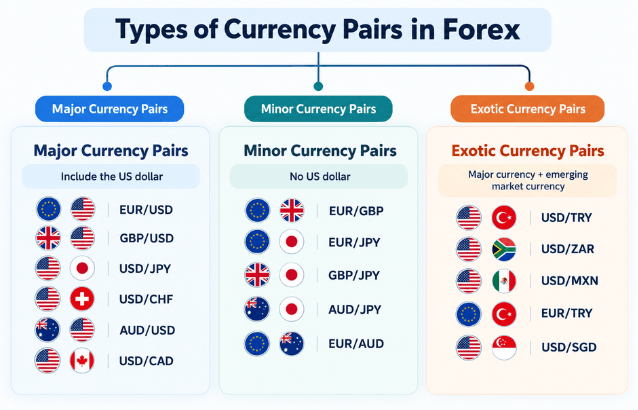
Currency pairs are commonly divided into three groups.
Major Currency Pairs
Major currency pairs combine the US dollar with another heavily traded currency. Examples include:
EUR/USD
GBP/USD
USD/JPY
USD/CHF
AUD/USD
USD/CAD
NZD/USD
These pairs generally attract substantial trading activity and often have deeper liquidity and tighter spreads than less frequently traded markets.
Minor Currency Pairs
Minor pairs, sometimes called cross currency pairs or crosses, combine major currencies without including the US dollar.
Examples include EUR/GBP, EUR/JPY and GBP/JPY.
They can still be actively traded, although liquidity and volatility vary between individual pairs.
Exotic Currency Pairs
Exotic pairs usually combine a major currency with the currency of an emerging or smaller economy.
Examples include USD/TRY, USD/ZAR and USD/MXN.
These markets may have wider spreads and can experience sharper movements, particularly when liquidity is lower or economic and political uncertainty increases.
What Are the Most Traded Currency Pairs?
The forex market is enormous. According to the Bank for International Settlements, average daily turnover in global over-the-counter foreign exchange markets reached US$9.6 trillion in April 2025, up 28% from US$7.5 trillion in 2022.
The US dollar remains at the centre of this activity, appearing on one side of 89.2% of all FX trades.
The BIS also reported the following shares for some of the most actively traded currency combinations:
Currency Pair
Share of Global FX Turnover in 2025
EUR/USD
21.2%
USD/JPY
14.3%
USD/CNY
8.1%
GBP/USD
7.6%
USD/CAD
5.3%
AUD/USD
4.9%
USD/CHF
4.9%
The BIS records currency combinations regardless of the usual market quotation order. The table above uses the quotation conventions traders commonly see on trading platforms.
Trading volume is only one consideration when choosing a market. If you are comparing the best forex currency pairs, it is also useful to consider liquidity, volatility, spreads, trading hours and the economic factors affecting each currency.
What Are Pips, Bid, Ask and Spread?
Currency pair prices are normally displayed using a bid price and an ask price.
For example:
EUR/USD: 1.0850 / 1.0852
The bid is 1.0850, while the ask is 1.0852. The difference between them is known as the spread.
In this example, the spread is:
1.0852 − 1.0850 = 0.0002, or 2 pips
A pip is a standard measurement of currency price movement. For many currency pairs, one pip equals 0.0001.
If EUR/USD moves from 1.0850 to 1.0860, it has moved 10 pips.
Japanese yen pairs are usually different. For a pair such as USD/JPY, one pip is typically 0.01.
Some trading platforms display an additional decimal place known as a fractional pip or pipette, which represents one-tenth of a pip.
Understanding the spread matters because it forms part of the cost of entering and exiting a forex position.
What Makes Currency Pairs Move?
Currency prices change as traders continuously reassess the outlook for the two economies represented by a pair.
Several factors can influence this relationship.
Interest rates and central banks: Decisions from institutions such as the Federal Reserve, European Central Bank, Bank of England and Bank of Japan can change expectations for currencies.
Inflation: Higher or lower inflation can influence expectations for future interest rates and monetary policy.
Economic growth: GDP, employment, retail sales and business activity data can change expectations about an economy’s strength.
Political and geopolitical developments: Elections, trade disputes, government policies and geopolitical tensions can create uncertainty and increase volatility.
Market sentiment: Changes in investors’ willingness to take risk can cause money to move between currencies and other financial markets.
It is also important to remember that both sides of the pair matter.
EUR/USD, for example, could fall because the US dollar is strengthening, because the euro is weakening, or because both are happening at the same time. This is why forex traders often analyse developments in both economies rather than concentrating on only one currency.
Can Currency Pairs Move Together?
Currency pairs are not completely independent.
EUR/USD, GBP/USD and AUD/USD all contain the US dollar as their quote currency. A major development that strengthens the dollar could therefore affect all three pairs at the same time.
This relationship is known as currency correlation.
Correlations can be positive or negative and can change over time. Traders should therefore be careful about assuming that historical relationships will always continue.
Understanding correlation can also help identify situations where several seemingly different trades actually create exposure to the same currency.
Which Currency Pair Is Best for Beginners?
There is no single pair that is automatically suitable for every beginner.
Many new traders start by observing heavily traded markets such as EUR/USD, GBP/USD or USD/JPY because economic information about the countries behind these currencies is widely available.
Highly traded pairs may also offer deeper liquidity, although spreads and volatility can still change significantly around major economic announcements.
Rather than watching dozens of pairs, beginners may find it easier to follow a small number first. Learn which economic releases affect them, when their busiest trading periods occur and how their prices normally respond to news.
The goal is not simply to choose the currency pair that moves the most. A suitable market should also fit your trading approach, preferred trading hours and tolerance for volatility.
Conclusion
Understanding what is a currency pair is one of the foundations of learning forex trading. Every pair compares two currencies, with the base currency listed first and the quote currency second.
From there, traders can learn how bid and ask prices work, how movements are measured in pips, why spreads differ and what economic factors influence exchange rates. Once these basics are clear, reading pairs such as EUR/USD, GBP/USD and USD/JPY becomes much easier.
FAQ
What is a currency pair example?
EUR/USD is a currency pair that compares the euro with the US dollar.
What are the two currencies in a currency pair called?
The first is the base currency and the second is the quote currency.
What does EUR/USD 1.1000 mean?
It means €1 is worth US$1.10.
What are the major currency pairs?
Major pairs include EUR/USD, GBP/USD, USD/JPY, USD/CHF, AUD/USD, USD/CAD and NZD/USD.
What is the most traded currency pair?
EUR/USD was the most actively traded currency combination in the 2025 BIS survey, representing 21.2% of global FX turnover.
Share Now
Disclaimer:This content is provided for informational purposes only and does not constitute, and should not be construed as, financial, investment, or other professional advice. No statement or opinion contained herein should be considered a recommendation by Ultima Markets or the author regarding any specific investment product, strategy, or transaction. Readers are advised not to rely solely on this material when making investment decisions and should seek independent advice where appropriate.
Thank you for visiting the Ultima Markets website. Please note that this website is intended for individuals residing in jurisdictions where access is permitted by law. Ultima and its affiliated entities do not operate in your home jurisdiction.
By clicking ‘Acknowledge’, you confirm that you are entering this website solely on your own initiative and not as a result of any specific marketing outreach. You wish to obtain information from this website based on reverse solicitation principles, in accordance with the applicable laws of your home jurisdiction.