This website is managed by Ultima Markets’ international entities, and it’s important to emphasise that they are not subject to regulation by the FCA in the UK. Therefore, you must understand that you will not have the FCA’s protection when investing through this website – for example:
You will not be guaranteed Negative Balance Protection
You will not be protected by FCA’s leverage restrictions
You will not have the right to settle disputes via the Financial Ombudsman Service (FOS)
You will not be protected by Financial Services Compensation Scheme (FSCS)
Any monies deposited will not be afforded the protection required under the FCA Client Assets Sourcebook. The level of protection for your funds will be determined by the regulations of the relevant local regulator.
Note: UK clients are kindly invited to visit https://www.ultima-markets.co.uk/. Ultima Markets UK expects to begin onboarding UK clients in accordance with FCA regulatory requirements in 2026.
If you would like to proceed and visit this website, you acknowledge and confirm the following:
1.The website is owned by Ultima Markets’ international entities and not by Ultima Markets UK Ltd, which is regulated by the FCA.
2.Ultima Markets Limited, or any of the Ultima Markets international entities, are neither based in the UK nor licensed by the FCA.
3.You are accessing the website at your own initiative and have not been solicited by Ultima Markets Limited in any way.
4.Investing through this website does not grant you the protections provided by the FCA.
5.Should you choose to invest through this website or with any of the international Ultima Markets entities, you will be subject to the rules and regulations of the relevant international regulatory authorities, not the FCA.
Ultima Markets wants to make it clear that we are duly licensed and authorised to offer the services and financial derivative products listed on our website. Individuals accessing this website and registering a trading account do so entirely of their own volition and without prior solicitation.
By confirming your decision to proceed with entering the website, you hereby affirm that this decision was solely initiated by you, and no solicitation has been made by any Ultima Markets entity.
Ultima Markets does not have an establishment in Singapore and does not operate from Singapore.
Ultima Markets does not provide products or services to citizens or residents of Singapore, and account applications from Singapore citizens or residents will not be accepted.
If you are a citizen or resident of Singapore, please do not open an account or use Ultima Markets’ products or services.
By selecting “Acknowledge and Continue Browsing”, you confirm that you are accessing this website on your own initiative and that your access is not the result of any direct marketing, targeted advertising, solicitation, or promotional activity by Ultima Markets.
Nothing on this website constitutes an offer, solicitation, or promotion of products or services in any jurisdiction where such activity is prohibited. You are responsible for ensuring that your access to and use of this website complies with applicable local laws and regulations.
What is gapping in trading? Learn why price gaps happen, the main gap types, how gaps may fill, and key risks including slippage and stop-loss execution.
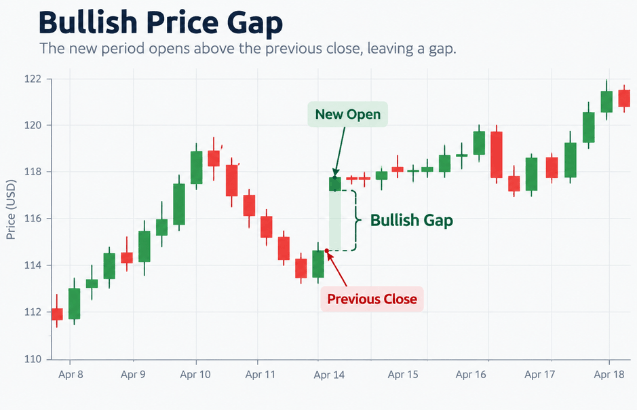
What is gapping in trading? Gapping happens when an asset’s price jumps abruptly from one level to another. It often describes a market opening above or below its previous closing price, although gaps can also occur during a trading session.
For traders, the important question is not simply whether a price has jumped. It is how to interpret that move and prepare for the possibility that an order will execute somewhere unexpected. This guide explains gap types, chart examples and the risks to consider before taking a position.
Gap Up vs Gap Down
Imagine a share closes at US$100. After unexpectedly strong earnings, it opens the following morning at US$105. This hypothetical move represents a gap up of US$5, or 5%. Opening at US$95 would represent a 5% gap down.
A partial opening gap stays within the previous session’s trading range. A full opening gap opens above its high or below its low.
Suppose the previous range was US$98 to USD$102, with a US$100 close. Opening at US$101 creates a partial gap up, while opening at US$105 creates a full gap up.
An opening gap does not always leave a lasting blank space between daily candles. Their ranges can overlap immediately or after price retraces during the session.
Chart settings also matter. A regular-session chart may omit extended-hours transactions, so a visible gap does not necessarily mean no trading occurred anywhere between those prices.
What Causes Gapping in Trading?
Gaps often follow information that changes expectations, such as earnings reports, takeover announcements or economic releases. When news arrives while a market is closed, the next opening price can reflect a different balance between buying and selling interest.
Thin liquidity, meaning limited trading interest at nearby prices, can also contribute to abrupt jumps during a session. A market does not have to close for a gap to develop.
Not every share-price gap reflects changing sentiment. An ex-dividend adjustment can also create a gap, so check the dividend calendar before interpreting the move as a change in investor confidence.
Trading schedules matter, too. Weekend access, daily breaks and holiday hours differ between products. Check the specific instrument’s schedule rather than assuming that everything linked to the same underlying market trades continuously.
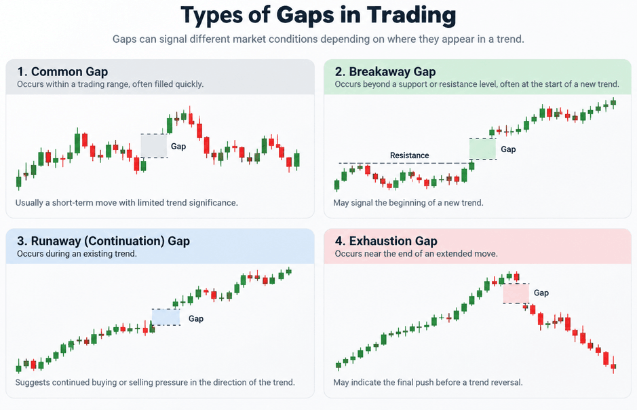
4 Main Types of Trading Gaps
Technical analysts commonly classify gaps according to where they appear within a price trend. The four main categories are outlined below.
Gap type
Where it appears
Possible interpretation
Common gap
Within an established trading range
A temporary disruption with limited trend significance
Breakaway gap
Beyond a range or key support or resistance
The potential beginning of a new trend
Runaway or continuation gap
During an existing trend
Continued buying or selling pressure
Exhaustion gap
Near the end of an extended move
A possible final push before a reversal
These labels are not instant trading signals. Distinguishing a continuation gap from an exhaustion gap often requires observing subsequent price action, rather than judging the opening move alone.
Do Price Gaps Always Fill?
No. There is no rule that every gap must close. A gap fill occurs when price retraces across the gap area. Common gaps may fill relatively quickly, while breakaway and continuation gaps can remain unfilled as a trend develops.
In the US$100 to US$105 example, returning to US$100 fully fills the close to open gap. Falling only to US$103 fills part of it.
That previous closing price is a useful reference point, but treating it as an inevitable destination would be an assumption, not a trading signal.
What Is Gapping in Trading Telling You?
Before applying gap trading strategies, consider what caused the gap, where it opened relative to the previous trading range and how the price behaved afterwards.
These checks provide context for two common approaches: following the initial move or anticipating a retracement.
Gap continuation means looking for price to keep moving in the gap’s direction. After an upward gap, traders might watch whether price holds above former resistance instead of immediately returning to its previous range.
Gap fading means trading against the initial move in anticipation of a retracement. It calls for evidence that the move is weakening, rather than assuming every gap will fill. Neither approach guarantees a profitable outcome.
Importantly, a gap up can still produce a falling candle. A share that previously closed at US$100 could open at US$105 and close at US$103. It opened higher but fell during that session. The opening gap compares sessions, while the candle body compares its own opening and closing prices.
How to Manage Gap Risk
The main practical concern is execution. A standard stock stop-loss becomes a market order when triggered, but its execution price is not guaranteed.
Suppose you buy a share at US$100 and set a stop-loss at US$97. If it gaps down and your order fills at US$90, your loss is US$10 per share rather than the intended US$3, before costs.
The gap is the price jump. The difference between the expected execution level and actual fill is slippage. In this example, the stop order experiences US$7 per share of adverse slippage.
A stop-limit order offers price control but may remain unfilled if the market jumps beyond its limit. Controlling the acceptable execution price does not guarantee an exit.
To manage exposure, consider smaller positions and whether holding through closures or major announcements suits your risk tolerance. For CFDs, check your provider’s execution terms and remember that leverage can magnify losses.
The key lesson is simple: a loss calculated from a standard stop-loss is a planned loss, not a guaranteed maximum.
Conclusion
So, what is gapping in trading? It is a jump between price levels that requires context, not an automatic buy or sell signal.
Focus on the cause, the surrounding trading range and the market’s response. Above all, account for the possibility that an exit order could execute beyond its intended level. Understanding the chart is only part of managing the trade.
FAQ
What is the difference between gapping and slippage?
Gapping is a jump between price levels. Slippage is the difference between an expected execution price and the actual fill. A gap can cause slippage.
Can gaps happen during the trading day?
Yes. Gaps can develop within a session, particularly when limited liquidity makes prices less continuous.
Does a gap up mean the price will keep rising?
No. Price can reverse after opening higher. The gap’s direction alone does not establish the next move.
Can a stop-loss protect against a gap?
It can trigger an exit, but a standard stop-loss does not guarantee execution at the chosen stop price.
Share Now
Disclaimer:This content is provided for informational purposes only and does not constitute, and should not be construed as, financial, investment, or other professional advice. No statement or opinion contained herein should be considered a recommendation by Ultima Markets or the author regarding any specific investment product, strategy, or transaction. Readers are advised not to rely solely on this material when making investment decisions and should seek independent advice where appropriate.
Thank you for visiting the Ultima Markets website. Please note that this website is intended for individuals residing in jurisdictions where access is permitted by law. Ultima and its affiliated entities do not operate in your home jurisdiction.
By clicking ‘Acknowledge’, you confirm that you are entering this website solely on your own initiative and not as a result of any specific marketing outreach. You wish to obtain information from this website based on reverse solicitation principles, in accordance with the applicable laws of your home jurisdiction.