This website is managed by Ultima Markets’ international entities, and it’s important to emphasise that they are not subject to regulation by the FCA in the UK. Therefore, you must understand that you will not have the FCA’s protection when investing through this website – for example:
You will not be guaranteed Negative Balance Protection
You will not be protected by FCA’s leverage restrictions
You will not have the right to settle disputes via the Financial Ombudsman Service (FOS)
You will not be protected by Financial Services Compensation Scheme (FSCS)
Any monies deposited will not be afforded the protection required under the FCA Client Assets Sourcebook. The level of protection for your funds will be determined by the regulations of the relevant local regulator.
Note: UK clients are kindly invited to visit https://www.ultima-markets.co.uk/. Ultima Markets UK expects to begin onboarding UK clients in accordance with FCA regulatory requirements in 2026.
If you would like to proceed and visit this website, you acknowledge and confirm the following:
1.The website is owned by Ultima Markets’ international entities and not by Ultima Markets UK Ltd, which is regulated by the FCA.
2.Ultima Markets Limited, or any of the Ultima Markets international entities, are neither based in the UK nor licensed by the FCA.
3.You are accessing the website at your own initiative and have not been solicited by Ultima Markets Limited in any way.
4.Investing through this website does not grant you the protections provided by the FCA.
5.Should you choose to invest through this website or with any of the international Ultima Markets entities, you will be subject to the rules and regulations of the relevant international regulatory authorities, not the FCA.
Ultima Markets wants to make it clear that we are duly licensed and authorised to offer the services and financial derivative products listed on our website. Individuals accessing this website and registering a trading account do so entirely of their own volition and without prior solicitation.
By confirming your decision to proceed with entering the website, you hereby affirm that this decision was solely initiated by you, and no solicitation has been made by any Ultima Markets entity.
Ultima Markets does not have an establishment in Singapore and does not operate from Singapore.
Ultima Markets does not provide products or services to citizens or residents of Singapore, and account applications from Singapore citizens or residents will not be accepted.
If you are a citizen or resident of Singapore, please do not open an account or use Ultima Markets’ products or services.
By selecting “Acknowledge and Continue Browsing”, you confirm that you are accessing this website on your own initiative and that your access is not the result of any direct marketing, targeted advertising, solicitation, or promotional activity by Ultima Markets.
Nothing on this website constitutes an offer, solicitation, or promotion of products or services in any jurisdiction where such activity is prohibited. You are responsible for ensuring that your access to and use of this website complies with applicable local laws and regulations.
meta description 153 characters
Learn what a trading portfolio is, how diversification, correlation and risk management work, and how to build a balanced approach to trading with focus.
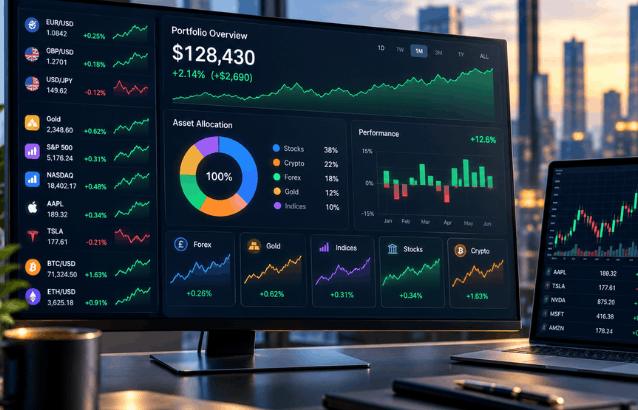
A trading portfolio is the collection of financial positions a trader manages across one or more markets. It may include forex pairs, commodities, indices, shares or cryptocurrencies, depending on the trader’s strategy and the instruments available through their broker.
However, building a trading portfolio is not simply about opening several different trades. Traders also need to consider how much risk each position carries, whether different markets are exposed to the same underlying factors, and how leverage could affect the portfolio as a whole.
Looking at trades collectively rather than one at a time can provide a clearer picture of overall exposure and help traders make more structured risk management decisions.
What Is a Trading Portfolio?
A trading portfolio consists of the positions that a trader holds and manages as part of an overall trading strategy.
For example, a trader might currently hold:
EUR/USD
Gold
Nasdaq 100
NVIDIA
Bitcoin
Together, these positions make up the trader’s portfolio.
The important point is that having several positions does not automatically mean the portfolio is diversified. Different markets can react to the same economic development.
For example, Nasdaq 100 and several major technology shares could all fall at the same time if sentiment towards the technology sector weakens. Likewise, EUR/USD and GBP/USD may both react strongly to a major change in expectations for US interest rates.
This is why traders should consider both individual opportunities and how those positions interact with the rest of the portfolio.
Trading Portfolio vs Investment Portfolio
A trading portfolio and an investment portfolio may contain similar assets, but they are generally managed differently.
An investment portfolio is typically built around medium- to long-term objectives. Investors may hold shares, ETFs or other assets for several years and focus on factors such as company growth, dividends and long-term capital appreciation.
A trading portfolio is usually managed more actively. Positions may be opened and closed based on price movements, technical signals, economic data, market sentiment or short-term fundamental developments.
Traders may also use leveraged products such as CFDs, making position size and overall portfolio exposure especially important.
What Can Be Included in a Trading Portfolio?
The exact composition depends on the trader’s strategy, experience and market knowledge.
Asset class
Examples
Common market drivers
Forex
EUR/USD, GBP/USD, USD/JPY
Interest rates, inflation, economic data
Commodities
Gold, silver, crude oil
Supply and demand, geopolitics, US dollar
Indices
S&P 500, Nasdaq 100, DAX 40
Earnings, economic conditions, sentiment
Shares
Apple, NVIDIA, Amazon
Earnings, company news, industry trends
Cryptocurrencies
Bitcoin, Ethereum
Liquidity, sentiment, regulation
Some traders specialise in one market. Others spread their activity across several asset classes.
Neither approach automatically creates a better portfolio. What matters is understanding the source and size of the risk behind each position.
How Does Diversification Work in a Trading Portfolio?
Diversification means spreading exposure so that the portfolio does not depend too heavily on a single market, sector or trading idea.
However, counting the number of positions can be misleading.
Imagine a trader holds:
Nasdaq 100
NVIDIA
Microsoft
Amazon
There are four separate positions, but each may be strongly influenced by sentiment towards US technology companies.
The same issue can occur in forex. A trader who is long EUR/USD, GBP/USD and AUD/USD may effectively have several positions based partly on the same expectation that the US dollar will weaken.
True diversification therefore involves looking at the underlying market drivers, not just the names of the instruments.
Traders can also diversify in different ways, including by:
Asset class
Industry or sector
Geographic market
Trading strategy
Holding period
For example, combining trend-following and range-trading strategies may reduce dependence on one specific type of market environment. It does not remove risk, but it can prevent every trade from relying on exactly the same conditions.
Why Correlation Matters
Correlation describes how closely two markets tend to move relative to each other.
Assets with a positive correlation often move in the same direction, while negatively correlated assets may move in opposite directions.
For traders, this is useful because several apparently separate trades may actually increase the same exposure.
For example, buying EUR/USD and GBP/USD at the same time may create greater exposure to US dollar weakness than the trader initially realises.
Correlation also changes over time. Markets that usually behave differently can begin moving together during periods of strong volatility, major central bank announcements or sudden changes in investor sentiment.
Historical relationships should therefore be treated as a guide rather than a guarantee.
How to Build a Trading Portfolio
A structured process can help traders build and manage their positions more consistently.
1. Define Your Trading Strategy
Start by deciding how you plan to trade.
You may focus on day trading, swing trading, trend following, breakout trading or a combination of strategies.
Your trading style affects how long positions remain open, how frequently they need to be monitored and how much exposure you might have at any one time.
2. Choose Markets You Understand
Beginners do not necessarily need to trade every available market.
Starting with a smaller group of instruments can make it easier to understand what drives their prices, how volatile they are and how they react to economic events.
Additional markets can be introduced gradually as knowledge and experience develop.
3. Set Risk for Each Position
Before opening a trade, consider how much of the account could be lost if the market reaches the planned exit point.
This requires looking at position size, stop-loss distance and leverage.
Equal capital allocation does not always mean equal risk. A highly volatile or heavily leveraged position may contribute much more risk to the portfolio than another position with a similar nominal value.
4. Calculate Total Open Risk
One of the most important steps is looking beyond risk on a single trade.
Consider this simple example:
Position
Risk if stop is reached
EUR/USD
1%
Gold
1%
Nasdaq 100
1%
Bitcoin
1%
Combined open risk
4%
Each trade may look manageable on its own, but the trader could potentially lose considerably more if several positions move against them at the same time.
For this reason, portfolio management should consider both risk per trade and total open risk.
5. Check for Overlapping Exposure
Before adding another position, ask whether it provides a genuinely different opportunity or simply increases an existing market bet.
For example, adding another technology share to a portfolio already containing the Nasdaq 100 and several semiconductor stocks could increase concentration rather than diversification.
6. Stress-Test the Portfolio
A simple stress test means asking how the portfolio might react to a major market event.
For example:
What happens if the US dollar suddenly strengthens?
A trader could then review their exposure to EUR/USD, GBP/USD, gold and other dollar-sensitive assets.
Or:
What happens if technology stocks fall sharply?
The trader could examine positions in the Nasdaq 100, semiconductor companies and individual technology shares.
This can reveal risks that may not be obvious when each position is viewed separately.
How to Review a Trading Portfolio
A trading portfolio should be reviewed regularly because its risk profile can change.
A profitable position may become much larger than initially intended. Volatility may increase. Several previously unrelated markets may begin moving together.
When reviewing the portfolio, consider:
Total open risk
Position sizes
Leverage
Correlation between trades
Exposure to the same sector or market theme
Whether each trade still matches the original strategy
The purpose is not to constantly change positions. It is to make sure the portfolio still reflects the trader’s planned level of risk.
Common Trading Portfolio Mistakes
One common mistake is assuming that more positions automatically mean better diversification.
Another is opening several correlated trades without recognising that they are driven by the same market factor.
Traders may also focus heavily on potential returns while ignoring leverage and total account exposure.
Over-diversification can create problems too. Managing too many positions can make it harder to follow important economic events, earnings announcements and technical developments.
A trading portfolio should therefore remain large enough to spread concentration risk but manageable enough for the trader to monitor properly.
Conclusion
A trading portfolio provides a way to view trading risk at the account level rather than treating every position as an isolated decision.
Building one effectively involves more than choosing several different instruments. Traders should consider position size, leverage, correlation, total open risk and whether multiple trades depend on the same underlying market theme.
Regularly reviewing these factors can help traders identify concentrated exposure before it becomes difficult to manage.
Ultima Markets provides access to more than 1,000 CFD instruments across forex, commodities, indices, shares and other global markets, allowing traders to explore opportunities across different asset classes. Whatever markets you choose, portfolio-level risk management should remain an important part of the trading process.
FAQs
What is a trading portfolio?
A trading portfolio is the collection of financial positions a trader manages as part of their overall trading strategy.
How do you build a trading portfolio?
Choose suitable markets, set position sizes, control individual and total risk, and check whether your positions are overly correlated.
What is portfolio diversification in trading?
It means spreading exposure across different markets, sectors or strategies rather than relying heavily on one source of risk.
Share Now
Disclaimer:This content is provided for informational purposes only and does not constitute, and should not be construed as, financial, investment, or other professional advice. No statement or opinion contained herein should be considered a recommendation by Ultima Markets or the author regarding any specific investment product, strategy, or transaction. Readers are advised not to rely solely on this material when making investment decisions and should seek independent advice where appropriate.
Thank you for visiting the Ultima Markets website. Please note that this website is intended for individuals residing in jurisdictions where access is permitted by law. Ultima and its affiliated entities do not operate in your home jurisdiction.
By clicking ‘Acknowledge’, you confirm that you are entering this website solely on your own initiative and not as a result of any specific marketing outreach. You wish to obtain information from this website based on reverse solicitation principles, in accordance with the applicable laws of your home jurisdiction.