This website is managed by Ultima Markets’ international entities, and it’s important to emphasise that they are not subject to regulation by the FCA in the UK. Therefore, you must understand that you will not have the FCA’s protection when investing through this website – for example:
You will not be guaranteed Negative Balance Protection
You will not be protected by FCA’s leverage restrictions
You will not have the right to settle disputes via the Financial Ombudsman Service (FOS)
You will not be protected by Financial Services Compensation Scheme (FSCS)
Any monies deposited will not be afforded the protection required under the FCA Client Assets Sourcebook. The level of protection for your funds will be determined by the regulations of the relevant local regulator.
Note: UK clients are kindly invited to visit https://www.ultima-markets.co.uk/. Ultima Markets UK expects to begin onboarding UK clients in accordance with FCA regulatory requirements in 2026.
If you would like to proceed and visit this website, you acknowledge and confirm the following:
1.The website is owned by Ultima Markets’ international entities and not by Ultima Markets UK Ltd, which is regulated by the FCA.
2.Ultima Markets Limited, or any of the Ultima Markets international entities, are neither based in the UK nor licensed by the FCA.
3.You are accessing the website at your own initiative and have not been solicited by Ultima Markets Limited in any way.
4.Investing through this website does not grant you the protections provided by the FCA.
5.Should you choose to invest through this website or with any of the international Ultima Markets entities, you will be subject to the rules and regulations of the relevant international regulatory authorities, not the FCA.
Ultima Markets wants to make it clear that we are duly licensed and authorised to offer the services and financial derivative products listed on our website. Individuals accessing this website and registering a trading account do so entirely of their own volition and without prior solicitation.
By confirming your decision to proceed with entering the website, you hereby affirm that this decision was solely initiated by you, and no solicitation has been made by any Ultima Markets entity.
Ultima Markets does not have an establishment in Singapore and does not operate from Singapore.
Ultima Markets does not provide products or services to citizens or residents of Singapore, and account applications from Singapore citizens or residents will not be accepted.
If you are a citizen or resident of Singapore, please do not open an account or use Ultima Markets’ products or services.
By selecting “Acknowledge and Continue Browsing”, you confirm that you are accessing this website on your own initiative and that your access is not the result of any direct marketing, targeted advertising, solicitation, or promotional activity by Ultima Markets.
Nothing on this website constitutes an offer, solicitation, or promotion of products or services in any jurisdiction where such activity is prohibited. You are responsible for ensuring that your access to and use of this website complies with applicable local laws and regulations.
Learn how to trade forex step by step, from currency pairs and market analysis to risk management, order types, trade execution, and position monitoring.
Learning how to trade forex involves more than simply choosing whether a currency will rise or fall. A forex trade requires you to select a currency pair, understand how its price is quoted, decide on a direction, calculate your position size and manage the trade once it is open.
For beginners, the process can initially appear complicated because several concepts are involved at the same time. Breaking the trade into individual steps makes it easier to understand what is actually happening before money is placed at risk.
What Do You Need to Know Before Trading Forex?
Forex is traded in currency pairs. When you see EUR/USD, for example, the euro is the base currency and the US dollar is the quote currency.
If EUR/USD is trading at 1.1800, this means one euro is valued at approximately US$1.18.
When trading the pair, you are effectively expressing a view on the relationship between the two currencies. Buying EUR/USD means you expect the euro to strengthen relative to the US dollar. Selling the pair means you expect the euro to weaken relative to the dollar.
Before learning how to trade forex, beginners should also understand several basic terms.
A pip measures a small change in the price of a currency pair. A spread is the difference between the bid and ask prices available in the market. A lot describes the size of a forex position, while margin and leverage determine how much capital is required to control a position.
These concepts affect both potential returns and potential losses, so they should be understood before placing a trade.
Step 1: Choose a Forex Currency Pair
The first practical step is deciding what you want to trade.
Forex markets contain many currency pairs, but beginners often start by studying major pairs such as EUR/USD, GBP/USD, USD/JPY and AUD/USD. These pairs involve major global currencies and typically attract substantial trading activity.
Do not choose a currency pair simply because it appears to be moving quickly. Consider whether you understand the currencies involved and what economic events may influence them.
For example, a trader following EUR/USD may need to pay attention to Federal Reserve and European Central Bank policy, US inflation, eurozone economic data and changes in market expectations for interest rates.
If you are unsure where to start, comparing the best forex currency pairs to trade can help you understand differences in liquidity, volatility and typical trading conditions.
Step 2: Decide Whether You Expect the Pair to Rise or Fall
Once you have selected a pair, the next part of learning how to trade forex is forming a market view.
Traders commonly combine two broad types of analysis.
Fundamental analysis examines factors that may influence the value of a currency, including interest rates, inflation, employment, economic growth and central bank policy.
Technical analysis focuses on price behaviour. Traders may examine trends, support and resistance levels, chart patterns, moving averages or momentum indicators to identify potential trading opportunities.
Neither approach can predict the market with certainty.
A more useful question is whether there is enough evidence to justify a trade and, just as importantly, what would prove the original idea wrong.
For instance, suppose GBP/USD has been trending upwards and repeatedly finding support near a particular price area. A trader may consider buying if the trend continues, while placing a stop below the level that would invalidate the setup.
Step 3: Calculate How Much You Are Prepared to Risk
Position sizing is one of the most important parts of forex trading.
Suppose a trader has a US$ 10,000 account and decide that the maximum acceptable loss on a particular trade is US$100.
If the stop loss is 50 pips away, the trader can use that distance and the acceptable monetary loss to determine an appropriate position size.
The important point is that the position size should come after deciding how much can be lost, rather than choosing a large position first and trying to fit the risk around it.
Leverage deserves particular attention here. It allows a trader to control a larger position with a smaller amount of margin, but it also increases exposure to price movements. Losses can therefore develop much faster when leverage is used.
Step 4: Choose How You Want to Enter the Market
After forming a trading idea, you need to decide how the position will be opened.
A market order attempts to execute the trade at the best available market price.
A pending order waits for the market to reach a specified level before being triggered.
For example, if EUR/USD is trading at 1.1750 but your analysis suggests that 1.1800 is an important breakout level, you might prefer to wait rather than immediately entering the market.
Trading platforms such as MetaTrader 5 support market and pending orders as well as Stop Loss and Take Profit instructions, giving traders different ways to manage entries and exits.
Step 5: Set Your Stop Loss and Take Profit
Knowing how you will exit a position is as important as knowing how you will enter it.
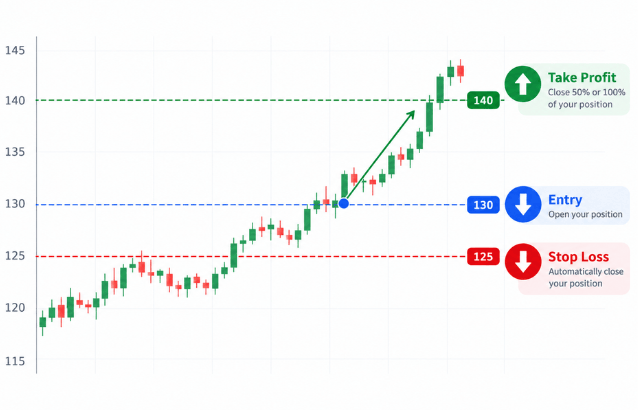
A Stop Loss is designed to close a position if the market moves far enough against your trade.
A Take Profit can close the position once a predetermined favourable price is reached.
Consider a simplified example.
GBP/USD is trading around 1.2500 and your analysis suggests that the pair could move higher.
You buy at 1.2500.
Your analysis becomes invalid below 1.2450, so you place the Stop Loss there. Your potential target is 1.2600.
The trade therefore has approximately 50 pips of downside between the entry and stop, compared with 100 pips between the entry and target.
This does not mean the trade will succeed. It simply means the potential outcome has been considered before the position is opened.
Step 6: Place the Forex Trade
Once the pair, direction, position size and exit levels have been decided, the order can be placed through your trading platform.
Check the details before confirming the order.
Pay particular attention to the currency pair, Buy or Sell direction, trade volume, Stop Loss and Take Profit levels.
One small error in position size can significantly change the amount of capital at risk.
After execution, your open position will usually display the entry price, current market price and unrealised profit or loss.
Step 7: Monitor and Close the Position
Learning how to trade forex does not end when you click Buy or Sell.
Prices can move as economic data, central bank comments, political developments and broader market sentiment change.
However, monitoring a trade does not necessarily mean constantly changing the original plan.
If a Stop Loss and target were chosen for a reason, repeatedly moving them because of short-term price fluctuations can undermine the risk plan.
A trade may eventually reach its target, hit its Stop Loss or be closed manually when market conditions change.
Trading costs should also be considered. Depending on the account and instrument, these may include spreads, commissions and overnight financing charges.
A Simple Forex Trade Example
Imagine USD/JPY is trading at 150.20.
Your analysis suggests that the pair could rise, so you decide to buy. Before entering, you identify 149.70 as the point at which your idea would no longer be valid and 151.20 as a possible target.
Rather than focusing only on the potential profit, you first calculate what the move to 149.70 would mean for your account.
You then adjust the position size to keep the potential loss within your predetermined limit.
This sequence is important.
The analysis identifies the opportunity. Risk management determines whether and how the opportunity should be traded.
Common Mistakes When Learning How to Trade Forex
Beginners sometimes concentrate on finding the perfect entry while giving much less attention to position size and exits.
Another common problem is trading too many currency pairs at once. Following EUR/USD, GBP/USD, USD/JPY and several less familiar currencies simultaneously can make it difficult to understand what is driving each market.
Excessive leverage can create an even larger problem because relatively small market movements may produce significant changes in account equity.
It is also worth remembering that a profitable trade does not automatically mean the process was good. A poorly planned trade can still make money, while a carefully planned trade can still lose.
The goal should be to develop a repeatable process rather than judge every decision solely by the result of one trade.
Conclusion
Understanding how to trade forex becomes much easier when the process is separated into clear decisions: choose the market, analyse the opportunity, define the risk, select the position size, plan the exit and only then place the trade.
Beginners do not need to trade every market movement. Spending time observing price behaviour and practising the order process can be valuable before moving to live trading.
With Ultima Markets, traders can access forex markets through platforms including MetaTrader 5 and explore tools for chart analysis, order management and risk control.
FAQs
How do beginners trade forex?
Beginners typically start by learning currency pairs, pips, spreads, position sizing and risk management before practising how to open and close trades.
How much money do I need to trade forex?
The amount varies according to the broker, account type, instrument and position size. More important than the starting balance is understanding how much capital is being risked on each trade.
How can I learn forex trading by myself?
Beginners can study forex concepts, chart analysis and risk management independently before practising with a demo account.
Is forex trading difficult?
The mechanics of placing a trade are relatively straightforward. Developing disciplined analysis and risk management usually takes considerably more practice.
What is the best forex pair for beginners?
There is no single best pair. Major pairs such as EUR/USD and GBP/USD are commonly studied because they are widely traded and have substantial market liquidity.
Share Now
Disclaimer:This content is provided for informational purposes only and does not constitute, and should not be construed as, financial, investment, or other professional advice. No statement or opinion contained herein should be considered a recommendation by Ultima Markets or the author regarding any specific investment product, strategy, or transaction. Readers are advised not to rely solely on this material when making investment decisions and should seek independent advice where appropriate.
Thank you for visiting the Ultima Markets website. Please note that this website is intended for individuals residing in jurisdictions where access is permitted by law. Ultima and its affiliated entities do not operate in your home jurisdiction.
By clicking ‘Acknowledge’, you confirm that you are entering this website solely on your own initiative and not as a result of any specific marketing outreach. You wish to obtain information from this website based on reverse solicitation principles, in accordance with the applicable laws of your home jurisdiction.